First Trimester of Pregnancy
From the beginning of pregnancy through approximately week 13: early fetal formation, first symptoms, and key early prenatal-care milestones.
Weeks 1–13Months 1–3
Advertisement
Medical note: gestational weeks are the more precise reference for pregnancy stage, while months are an approximate way to understand where you are in the journey. This content is educational and does not provide diagnosis or an individualized treatment plan.
The first trimester aligns closely with months 1–3 in the pregnancy month guide.
Weeks 1–13Months 1–3
First trimester of pregnancy: weeks 1 through 13
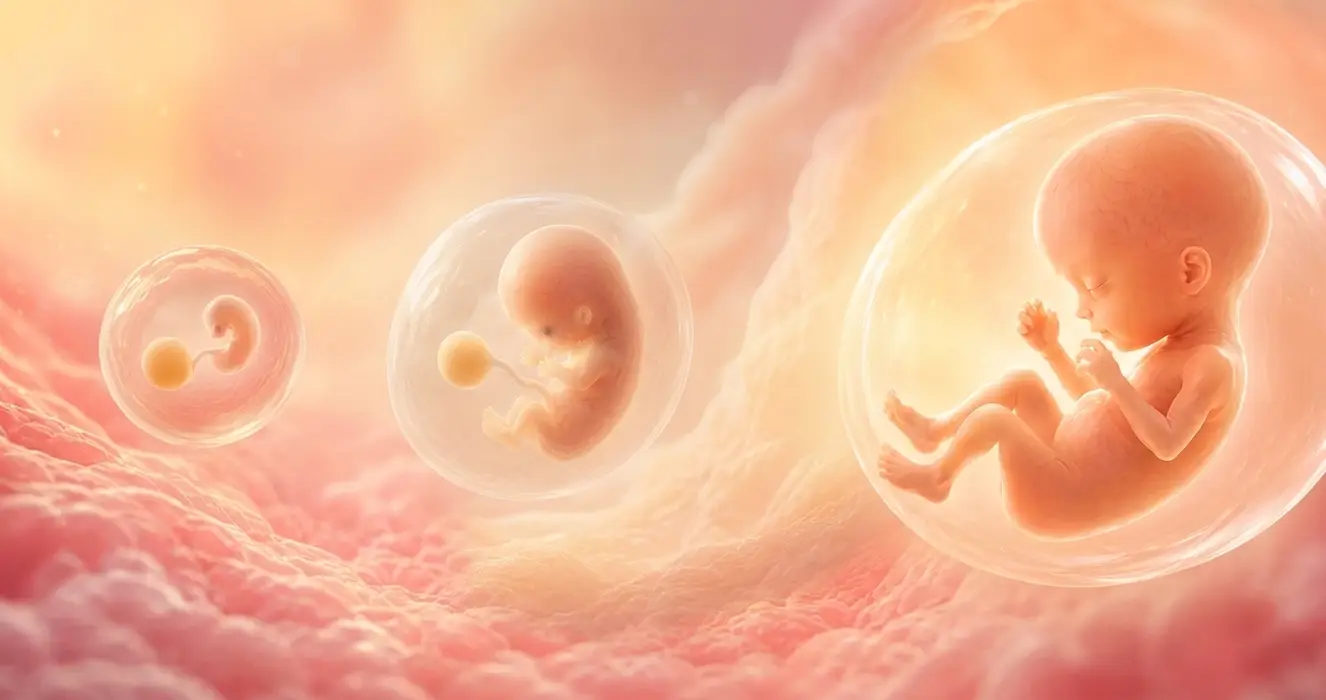
The first trimester begins at the start of pregnancy dating and continues through approximately the end of week 13. During this stage, implantation occurs, the placenta begins developing, and the foundations of the brain, nervous system, heart and other major organs form.
For you, this stage may raise many questions: Are these symptoms normal? When should you see a clinician? When should pregnancy appear on ultrasound? What are NT and NIPT? Which tests matter? And which symptoms should not be ignored?
This page gives you the big picture of the first trimester, then links you to the relevant pregnancy month and week when you need more precise detail.
This information is educational. Heavy bleeding, severe or persistent pain, fainting, marked one-sided abdominal pain, shoulder pain, fever or severe vomiting with dehydration requires medical assessment.
Which weeks and months are in the first trimester?
This guide places the first trimester across weeks 1–13, broadly corresponding to the first three pregnancy months.
- Month 1: weeks 1–4.
- Month 2: weeks 5–8.
- Month 3: weeks 9–13.
You can also open month 1, month 2 and month 3.
Why does pregnancy dating start before conception?
Pregnancy is conventionally dated from the first day of the last menstrual period rather than the day of fertilization. This is why the first two gestational weeks are included even though conception usually happens later.
How does the fetus develop during the first trimester?
Weeks 1–4: fertilization and implantation
Ovulation and fertilization occur, followed by rapid cell division and movement toward the uterus. Implantation then occurs in the uterine lining, and hCG levels begin to rise.
Weeks 5–8: rapid early organ formation
Early brain and nervous-system structures develop, while the heart and circulation begin forming and functioning. Limb buds and early facial features also become more defined.
Because this is a major organ-development stage, review medicines, supplements and herbal products with your clinician.
Weeks 9–13: increasingly recognizable fetal development
Organs that formed earlier continue growing and maturing. The face, limbs and body become more recognizable and early fetal movement begins, although you usually cannot feel it yet.
Common first-trimester symptoms
Symptoms vary widely. Strong symptoms can occur in a healthy pregnancy, while another healthy pregnancy may produce relatively few symptoms.
- A missed period.
- Nausea with or without vomiting.
- Fatigue and sleepiness.
- Breast tenderness.
- Frequent urination.
- Bloating and digestive changes.
- Food aversions or appetite changes.
- Heightened sensitivity to smells.
- Mood changes.
- Mild lower-abdominal pulling or cramping in some women.
When does nausea start and when does it improve?
Nausea can begin early in pregnancy, often becomes more noticeable during part of the first trimester, and improves toward the end of this stage for many women.
Small frequent meals, avoiding personal food or smell triggers and drinking fluids in smaller amounts throughout the day may help.
Seek assessment if vomiting prevents you from keeping fluids down, urine output falls, or you develop significant dizziness or dehydration.
When is the first prenatal visit in Saudi Arabia?
Saudi Ministry of Health guidance places the first prenatal visit after pregnancy is recognized and before 12 completed weeks.
The visit may include pregnancy registration, health and pregnancy history, a clinical examination, medication review, pregnancy-risk classification, laboratory testing and planning for ultrasound and follow-up.
Which tests may be requested at the first visit?
Saudi prenatal guidance includes several early screening tests. Exact testing can vary according to clinical circumstances and local protocols.
- Blood group and Rh factor.
- Complete blood count CBC.
- Ferritin.
- Urinalysis and urine culture.
- Early glucose assessment.
- Thyroid testing.
- Selected infection screening.
- Indirect Coombs testing when included in the care pathway.
When is the first routine pregnancy ultrasound?
In the Saudi prenatal pathway, the first routine ultrasound is scheduled between weeks 11 and 14.
Earlier ultrasound may be appropriate if bleeding, pain or another clinical reason requires confirmation of pregnancy location or development.
When do the gestational sac and heartbeat appear?
What can be seen depends on true gestational age, ovulation timing, dating accuracy and the type of ultrasound used.
If an ultrasound is performed very early, not seeing every expected structure does not automatically mean that the pregnancy is abnormal. A repeat scan may be recommended.
What is the NT scan?
Nuchal translucency, or NT screening, uses ultrasound to measure a fluid-filled space at the back of the fetal neck during the appropriate first-trimester window.
It is a screening tool that contributes to risk assessment for certain chromosomal abnormalities and other conditions. It is not a diagnosis on its own.
What is NIPT and when can it be done?
NIPT or cfDNA screening analyzes placental DNA fragments circulating in maternal blood.
It can generally be performed from 10 weeks of pregnancy.
It is a screening test for the risk of common fetal aneuploidies, not a diagnostic test. A high-risk result should be followed by appropriate counseling and discussion of diagnostic testing.
Do you need both NT and NIPT?
There is no single screening plan that is right for every pregnancy. The best approach depends on clinical history, ultrasound findings, personal preferences and the screening options available.
Screening estimates risk. Diagnostic testing is different and is used when a more definitive answer is required.
Folic acid during the first trimester
Saudi Ministry of Health guidance recommends 400 micrograms of folic acid daily for most women when trying to conceive and through week 12.
Some women need a higher dose because of specific medical or pregnancy-history factors. The higher dose should be prescribed by a clinician.
Iron and ferritin during early pregnancy
CBC and ferritin help identify anemia or low iron stores early in pregnancy. Supplement choice and dose should be based on your results and clinical assessment.
Nutrition during the first trimester
You do not need to double the quantity of food you eat. Food quality, safety and nutritional variety are more important.
- Choose well-cooked protein sources.
- Wash fruit and vegetables thoroughly.
- Include fiber-rich foods.
- Choose pasteurized dairy products.
- Include safe dietary sources of iron and calcium.
- Drink fluids regularly.
Avoid raw or undercooked meat and eggs, raw seafood and unpasteurized dairy products. Discuss excessive caffeine intake, supplements and herbal products with your clinician.
Medicines and supplements in early pregnancy
Do not assume that an over-the-counter or herbal product is automatically safe in pregnancy.
At the same time, do not abruptly stop an important prescribed medicine for a chronic condition without medical advice.
Bring a complete list of medicines, vitamins and supplements to your first prenatal visit.
Bleeding during the first trimester
Light spotting can occur in early pregnancy, but its cause cannot be determined from the amount of bleeding alone.
Seek more urgent assessment if bleeding becomes heavy or is associated with severe pain, marked one-sided abdominal pain, shoulder pain, significant dizziness or fainting.
Ectopic pregnancy warning symptoms
Symptoms alone cannot diagnose an ectopic pregnancy, but certain combinations require prompt assessment.
- Severe or increasing one-sided abdominal pain.
- Unusual vaginal bleeding.
- Shoulder-tip pain.
- Severe dizziness or fainting.
- Marked weakness or clinical deterioration.
Practical first-trimester checklist
- Arrange your first prenatal visit after pregnancy is recognized.
- Take folic acid according to your care plan.
- Review medicines, vitamins and supplements.
- Complete the first-visit laboratory tests requested by your care team.
- Plan the 11–14 week ultrasound.
- Discuss NT, NIPT or other genetic-screening options if desired.
- Avoid smoking, alcohol and high-risk foods.
- Maintain hydration and manageable nutrition when nausea is present.
- Know the symptoms that require prompt assessment.
First trimester week by week
- Weeks 1–2: pregnancy dating and preparation for ovulation.
- Week 3: fertilization and early cell division.
- Week 4: implantation and early pregnancy testing.
- Week 5: rapid early development begins.
- Week 6: early cardiac and nervous-system development.
- Week 7: continued organ and facial development.
- Week 8: rapid embryonic development continues.
- Week 9: transition into a more recognizable fetal stage.
- Week 10: NIPT can be discussed from this point.
- Week 11: the 11–14 week ultrasound window begins.
- Week 12: near the end of routine folic-acid supplementation for most women.
- Week 13: the end of trimester 1 approaches.
What comes after the first trimester?
After week 13, move into the second trimester of pregnancy.
For many women, some early pregnancy symptoms begin to improve, the pregnancy becomes more visible, and the next stage brings fetal movement, the anatomy scan and mid-pregnancy screening.
Medical basis for this guide
This guide is based on the Saudi Ministry of Health prenatal-care pathway and first-visit guidance, together with current professional guidance on first-trimester genetic screening.
Weeks in this trimester
Choose your pregnancy week when you need precise information about fetal development, symptoms, testing and prenatal follow-up.
Months linked to this trimester
If you follow pregnancy by month, move directly to the relevant month. One month can overlap two trimesters because month and trimester boundaries do not align perfectly.
First Trimester of Pregnancy FAQs
When does the first trimester start and end?
The first trimester extends from the beginning of pregnancy dating through approximately the end of week 13.It broadly covers months 1–3: month 1 weeks 1–4, month 2 weeks 5–8 and month 3 weeks 9–13.
When should I have my first prenatal visit?
Saudi Ministry of Health guidance places the first visit after pregnancy is recognized and before 12 completed weeks.The visit typically reviews health history, medicines, pregnancy risk, physical assessment, early laboratory tests and planning for ultrasound and follow-up.
When is the first routine pregnancy ultrasound?
The first routine ultrasound in the Saudi pathway is generally performed between weeks 11 and 14.Earlier ultrasound may be used when bleeding, pain or another clinical reason requires assessment of pregnancy location or development.
When can NIPT be performed?
NIPT or cfDNA screening can generally be performed from 10 weeks.It is a screening test for the risk of common fetal aneuploidies and is not diagnostic. A high-risk result requires appropriate counseling and discussion of diagnostic testing.
What is the difference between NT and NIPT?
NT is an ultrasound measurement, while NIPT is a maternal blood test based on cfDNA.Both are screening approaches rather than definitive diagnosis. The most appropriate screening plan depends on gestational age, history, ultrasound findings and personal preferences.
How much folic acid is recommended in the first trimester?
Saudi guidance recommends 400 micrograms daily for most women through week 12.Some women require a higher dose because of specific medical or pregnancy-history factors. The higher dose should be prescribed by a clinician.
Is light bleeding normal in early pregnancy?
Light spotting can occur, but the cause cannot be determined from bleeding alone.Seek more urgent assessment if bleeding is heavy or associated with severe pain, one-sided pain, shoulder pain, marked dizziness or fainting.
When does vomiting require medical assessment?
Seek care if you cannot keep fluids down or develop dehydration, markedly reduced urination or significant dizziness.Nausea is common in the first trimester, but severe vomiting may require treatment to protect hydration, nutrition and overall health.
Pregnancy & Birth Library Stages
Explore library content by the stage most relevant to you.




Advertisement
Follow the latest pregnancy and birth content
Subscribe for new educational content from LahaLak.
Booking step
Ready to choose the right maternity package?
Compare hospitals and prices by city and birth type, then continue to booking with clear steps.