Insight Hub

Your feedback helps us raise our care standards.

LahaLak logo
LahaLakHealth Nexus | LahaLak Medical Services Office

We shape a clearer and more trusted care journey by combining medical expertise with digital technology.

Discovery

  • Vision & Mission
  • Elixir Blog
  • Success Stories

Ecosystem

  • Ambassador Program
  • Career Paths
  • Join as an Accredited Care Center
  • Practitioner Entry

Secure Access Node

Active Node

Support & Complaints Unit

0599489990

الخط المباشر|Direct Secure Line

Global Payments | سداد آمن
Privacy
Disclaimer
Editorial Policy & Medical Standards
Beneficiary Rights
Official IBAN
SA21 1000 0011 7000 0034 5102

All rights reserved to LahaLak Medical Platform © 2026
Exclusive Operator: LahaLak Medical Services Office

Reusing or copying platform content, designs, or ideas for commercial use is prohibited without prior written permission.

SBC: 0000209083CR: 4030402711VAT: 300095977700003SAIP: 1443017765BASE: Jeddah 23323
Lahalak Logo
Lahalak Medical PlatformDifferentiate Care
جاري تحميل مقال إكسير
Home›Elixir›Medical News›When Does a Benign Skin Tumor Need to Be Removed? Reasons & Options
Medical News

When Does a Benign Skin Tumor Need to Be Removed? Reasons & Options

Find out when benign skin tumors require removal, the best clinical methods available, and essential post-procedure recovery tips.
By: LahaLak Medical PlatformPublished: October 6, 2026Updated: October 15, 20269 min read9 views
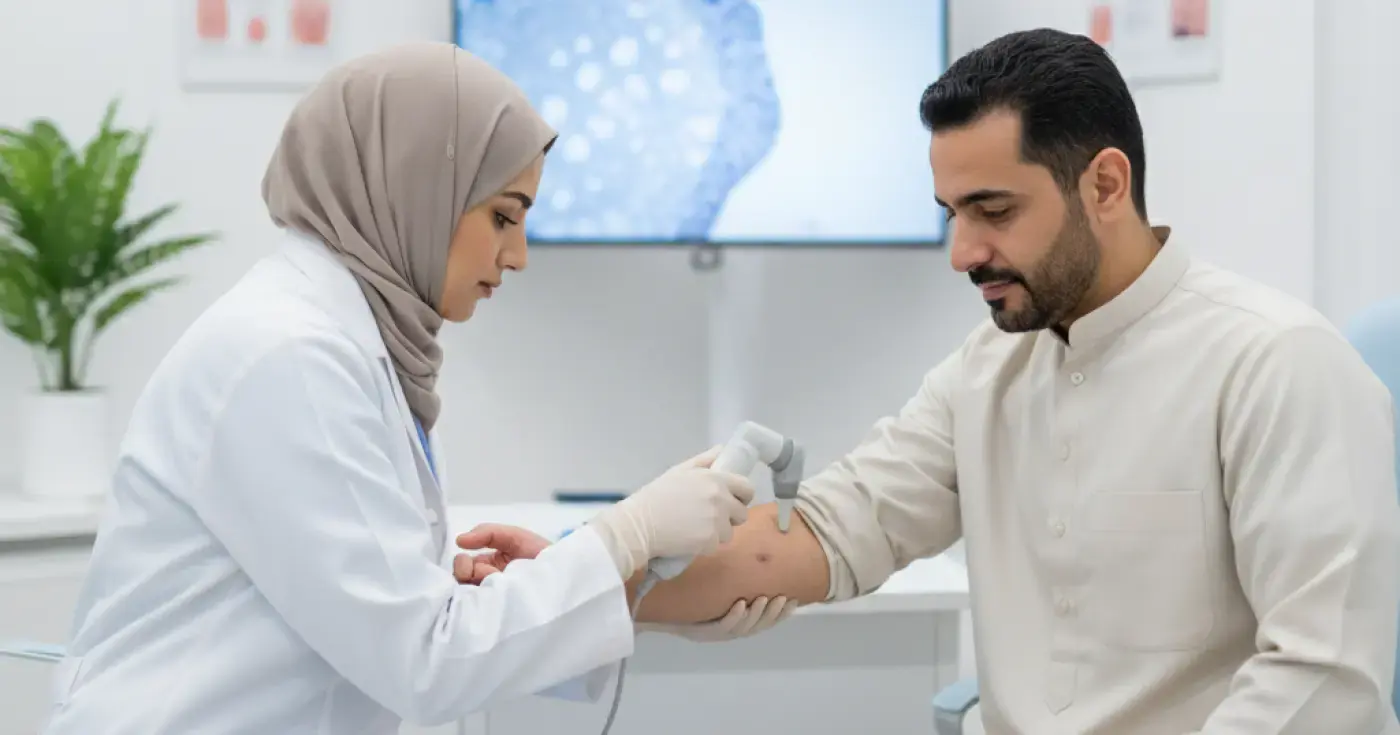
Dermatologist examining a patient's skin mole with a dermoscope in a clinical setting
Health education content
Sources are listed
Does not replace a clinician
Publication dates are transparent

Advertisement

Medical notice: this content is for health education and does not provide an individual diagnosis or replace appropriate medical consultation.

Introduction to Benign Skin Tumors

Benign skin tumors are highly common non-cancerous growths that can appear on any part of the body. Unlike malignant lesions, benign tumors do not invade surrounding tissues or spread to other organs. However, deciding whether to keep or remove these growths depends on clinical evaluations, functional impact, and cosmetic preferences determined during a professional medical assessment.

Common Types of Benign Skin Growths

There are several types of benign skin lesions, each originating from different skin cells:

  • Nevi (Moles): Clusters of pigmented cells that vary in size, shape, and color.
  • Seborrheic Keratoses: Common, harmless skin growths that often appear "stuck-on" the skin, frequently seen in older adults.
  • Lipomas: Soft, fatty masses located just beneath the skin that move easily when touched.
  • Dermatofibromas: Small, firm, red-to-brown nodules that typically develop on the lower legs, often following minor trauma or insect bites.
  • Skin Tags (Acrochordons): Small, soft, flesh-colored growths that typically form in areas where skin rubs against skin or clothing.

When is Removal Medically Necessary?

Although these lesions are non-cancerous, certain clinical situations make removal the recommended course of action:

1. Chronic Friction and Irritation

If a benign growth is located in an area prone to constant rubbing—such as the collar line, underarms, or groin—it can become irritated, painful, or bleed repeatedly. In such cases, mole removal or skin tag excision is highly beneficial to prevent secondary bacterial infections.

2. Diagnostic Uncertainty

When a lesion exhibits atypical features, a dermatologist may not be able to rule out malignancy through visual inspection alone. Performing a skin biopsy or complete excision allows for histopathological analysis to confirm that the growth is entirely benign.

3. Functional Impairment

Large benign tumors, such as deep lipomas or epidermoid cysts, can press against nerves, restrict joint movement, or interfere with daily functions (e.g., a growth near the eyelid obstructing vision). Surgical removal is necessary in these cases to restore normal function and relieve discomfort.

4. Recurrent Inflammation and Infection

Cystic lesions can become clogged, leading to painful inflammation and abscess formation. Once the acute infection is resolved with medical therapy, surgical excision of the cyst wall is recommended to prevent recurrence.

Cosmetic Reasons for Removal

Many individuals seek removal for cosmetic reasons, especially when benign lesions appear on prominent areas like the face, neck, or hands. While cosmetic removal can significantly boost self-confidence, patients should discuss realistic outcomes with their doctor, as some removal methods may leave minor scars that could be more noticeable than the original lesion.

Clinical Methods for Removing Benign Skin Tumors

Dermatologists utilize various safe, in-office techniques depending on the tumor's type, size, and depth:

Procedure Mechanism Common Indications
Surgical Excision Cutting out the entire lesion and suturing the wound under local anesthesia. Lipomas, deep moles, and epidermoid cysts.
Shave Excision Shaving the growth flush with the skin surface using a small blade. Raised moles and prominent skin tags.
Cryotherapy Applying liquid nitrogen to freeze and destroy the lesion. Seborrheic keratoses and common warts.
Laser Therapy Using focused light beams to vaporize the tissue precisely. Small vascular lesions and superficial skin tags.

Diagnosis Before Removal

Before any procedure, a thorough dermatologist consultation is essential. The specialist will examine the lesion using a dermoscope to evaluate its pigment patterns and structure. This step ensures that the correct treatment plan is selected and that any suspicious lesions are identified early.

Post-Procedure Care and Recovery

Proper wound care is vital for minimizing scarring and preventing infection. Key post-care steps include:

  • Keeping the wound clean and dry for the first 24 to 48 hours.
  • Applying prescribed topical ointments or medical petroleum jelly to keep the wound moist.
  • Avoiding picking at any scabs that form, allowing them to fall off naturally.
  • Applying broad-spectrum sunscreen diligently to protect the healing skin from hyperpigmentation.

Warning Signs: When to See a Doctor Immediately

Patients should monitor their skin regularly and seek immediate medical attention if any lesion shows signs of the ABCDE criteria:

  • Asymmetry: One half of the mole does not match the other half.
  • Border: The edges are irregular, ragged, or blurred.
  • Color: The color is not uniform and may include shades of brown, black, pink, or red.
  • Diameter: The lesion is larger than 6 mm (about the size of a pencil eraser).
  • Evolving: The growth is changing in size, shape, color, or is bleeding, itching, or crusting.

Conclusion and LahaLak Medical Advice

While most benign skin tumors are harmless, their removal should always be performed by a qualified medical professional in a sterile clinical environment. Attempting DIY home removal methods can lead to severe infections, chemical burns, and permanent scarring. Prioritize your skin health by scheduling regular professional skin checks to ensure safety and peace of mind.

Sources and References

  1. Ministry of Health Saudi Arabia
  2. World Health Organization
  3. MedlinePlus
  4. Centers for Disease Control and Prevention CDC
  5. American College of Obstetricians and Gynecologists ACOG

Clear, direct answers

Frequently Asked Questions

Can a benign skin tumor become malignant?+
Most benign skin tumors remain benign and do not transform into cancer. However, certain atypical moles require regular monitoring by a dermatologist to detect any early signs of dysplastic changes.
Does removing a benign skin tumor leave a scar?+
Scarring depends on the removal method, size, and location of the lesion, as well as individual healing characteristics. Surgical excision typically leaves a faint linear scar, while superficial methods like shave excision or cryotherapy leave minimal marks.
Can I remove skin tags at home?+
Home removal of skin tags or moles using threads, scissors, or over-the-counter chemical kits is highly discouraged. It carries a high risk of severe bleeding, bacterial infection, and permanent scarring.
Is the removal of benign skin tumors painful?+
Most clinical removals are performed under local anesthesia, making the procedure itself virtually painless. Any mild post-procedure discomfort can be easily managed with over-the-counter pain relievers.
How long does it take to heal after skin tumor removal?+
Superficial wounds usually heal within 1 to 2 weeks. Deeper surgical excisions may take several weeks to heal completely, and sutures are typically removed within 5 to 14 days depending on the area.

Explore the topic

Related articles

  • Distinguishing Benign Skin Tumors from Warning Signs: A Clinical GuideElixir · Health Panorama
  • Benign Skin Tumors: A Comprehensive Guide to Types and TreatmentElixir · Health Panorama
  • When Does a Mole Need to Be Examined Before Removal?Elixir · Health Panorama

Elixir

Explore health content

Medical News

Browse Elixir sections and continue exploring content related to this article.

Medical NewsConsumer AwarenessInspiring Stories

Advertisement

Your opinion matters

Was this content helpful?

Have a note?

Comments require login.Log in
Loading comments
Loading related articles

Continue exploring

Related Articles

Distinguishing Benign Skin Tumors from Warning Signs: A Clinical Guide

Distinguishing Benign Skin Tumors from Warning Signs: A Clinical Guide

Learn how to differentiate benign skin tumors from suspicious changes using the ABCDE rule and when to consult a dermatologist for a professional evaluation.

Read article
Benign Skin Tumors: A Comprehensive Guide to Types and Treatment

Benign Skin Tumors: A Comprehensive Guide to Types and Treatment

A comprehensive medical guide to benign skin tumors, common types like moles and skin tags, differentiation from cancer, and when to consult a dermatologist.

Read article

When Does a Mole Need to Be Examined Before Removal?

When Does a Mole Need to Be Examined Before Removal?

Learn when a mole requires medical examination before removal, the ABCDE criteria, and safe dermatological procedures to prevent complications.

Read article