
Lahalak Medical PlatformDifferentiate Care
Learn how to differentiate benign skin tumors from suspicious changes using the ABCDE rule and when to consult a dermatologist for a professional evaluation.

Advertisement
As the body's largest organ and its primary protective barrier, the skin is constantly exposed to environmental stressors, including ultraviolet (UV) radiation, chemicals, and the natural aging process. Over time, it is common to develop new spots, bumps, or moles. In the vast majority of cases, these growths are benign skin tumors that pose no threat to health. However, some changes can be early indicators of precancerous or cancerous conditions that require prompt medical intervention. Understanding how to differentiate between normal, benign growths and suspicious changes is a vital step in proactive healthcare and early detection.
Benign skin tumors are non-cancerous growths of skin cells. They do not invade surrounding tissues or spread to other parts of the body. These lesions vary widely in appearance, texture, and origin. Some of the most common types include:
Dermatologists have established a simple, universally recognized mnemonic called the ABCDE rule to help individuals monitor their moles and identify potential warning signs of melanoma, the most serious form of skin cancer:
In addition to the ABCDE criteria, there are other clinical signs on your skin that should never be ignored:
The following table summarizes the key clinical differences between benign skin tumors and suspicious changes that warrant professional medical examination:
| Feature | Benign Skin Tumor | Suspicious Changes (Seek Evaluation) |
|---|---|---|
| Symmetry | Symmetrical, round, or oval shape | Asymmetrical, irregular, or jagged shape |
| Borders | Smooth, distinct, and well-defined | Irregular, notched, scalloped, or blurred |
| Color | Single, uniform color (brown, pink, or black) | Multiple colors or uneven shades within the same lesion |
| Diameter | Usually stable and under 6 mm | Growing rapidly or larger than 6 mm |
| Symptoms | Asymptomatic (no pain, itching, or bleeding) | May itch, hurt, scale, ooze, or bleed spontaneously |
| Evolution | Remains unchanged over many years | Changes in size, shape, color, or elevation over weeks/months |
It is highly recommended to perform a Fshp_Al-Thati_Lish-Shamat (skin self-exam) once a month in a well-lit room, using mirrors to inspect hard-to-see areas like your back and scalp. You should schedule a clinical fahs_al-jild_al-sariri (professional skin exam) with a dermatologist if:
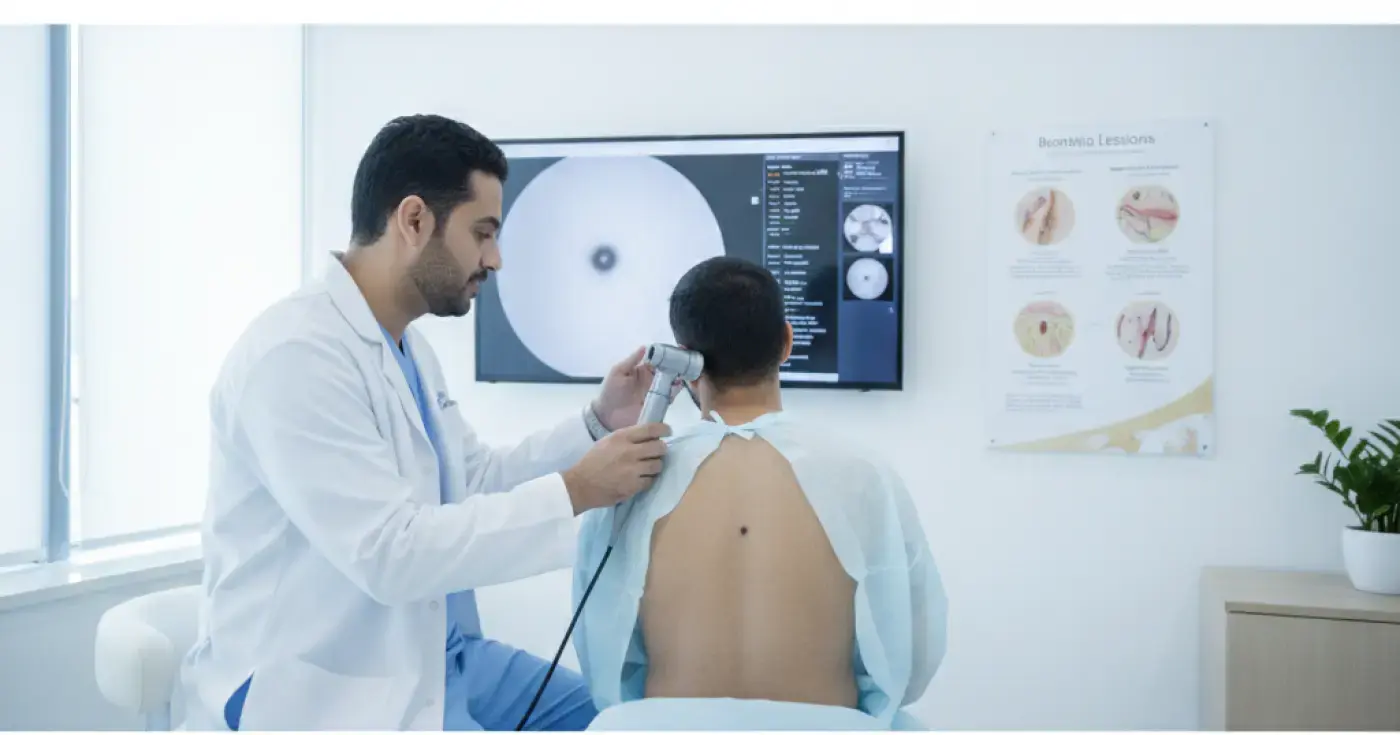
During your visit, the dermatologist will thoroughly examine your skin using a specialized tool called a dermoscope. This is a handheld magnifier with a polarized light source that allows the doctor to see the microscopic structures of the skin and pigment patterns that are invisible to the naked eye. If a lesion looks suspicious, the doctor will not rely solely on visual inspection. They will perform a khuz'at_al-jild (skin biopsy), a quick and minimally invasive procedure where the area is numbed with a local anesthetic, and a small tissue sample is removed to be analyzed under a microscope in a pathology lab for a definitive diagnosis.
Protecting your skin from harmful ultraviolet radiation is the single most effective way to prevent cellular damage and reduce the risk of developing suspicious skin changes. Follow these essential preventive measures:
Discovering a benign skin tumor is incredibly common and should not cause panic. However, maintaining vigilance and regularly monitoring your skin is the cornerstone of early detection and prevention. Remember that self-examinations are an excellent screening tool but can never replace a professional medical diagnosis. When detected early, the treatment of suspicious skin changes is highly successful, often resulting in complete recovery. If you notice any spot that looks unusual or has changed, do not hesitate to consult a dermatologist for peace of mind.
Clear, direct answers
Advertisement
Continue exploring
A comprehensive medical guide to benign skin tumors, common types like moles and skin tags, differentiation from cancer, and when to consult a dermatologist.
Read article
Learn when a mole requires medical examination before removal, the ABCDE criteria, and safe dermatological procedures to prevent complications.
Read article
Learn why moles and skin tags can grow back after removal, the recurrence risks of different methods, and when to see a dermatologist.
Read article