
Lahalak Medical PlatformDifferentiate Care
Learn when a mole requires medical examination before removal, the ABCDE criteria, and safe dermatological procedures to prevent complications.
Advertisement
Moles (nevi) are extremely common skin growths that most people have. They typically appear as small, dark brown or black spots caused by clusters of pigmented cells (melanocytes). In the vast majority of cases, moles are completely benign and pose no threat to your health. However, many individuals consider removing them for cosmetic reasons or because they cause discomfort when rubbing against clothing.
From a clinical standpoint, a mole cannot be treated as a simple cosmetic issue that can be removed immediately. Certain circumstances indicate that a mole may harbor abnormal cellular changes or even represent melanoma (a serious form of skin cancer). Therefore, undergoing a regular skin check and consulting a specialist before removal is a vital preventive step to protect your health.
The primary reason to examine a mole before removal is to rule out malignancy. When someone removes a suspicious mole using quick cosmetic methods without a histological examination, they risk leaving active cancer cells beneath the skin. This can lead to local recurrence or metastasis to other organs without the patient's knowledge.
Dermatologists have established a simple, globally recognized standard to help individuals monitor their moles and determine if they require urgent clinical evaluation. This is known as the "ABCDE rule":
| Letter | Feature | Clinical Description | Warning Sign (Requires Evaluation) |
|---|---|---|---|
| A | Asymmetry | The shape of the mole | If you draw a line through the middle, the two halves do not match. |
| B | Border | The edges of the mole | The borders are irregular, scalloped, notched, or poorly defined. |
| C | Color | The shading of the mole | The color is not uniform; it has shades of brown, black, red, pink, or blue. |
| D | Diameter | The size of the mole | The diameter is larger than 6 mm (about the size of a pencil eraser). |
| E | Evolving | Changes over time | Any change in size, shape, color, or the appearance of new symptoms like itching or bleeding. |
In addition to the ABCDE criteria, there are other clinical signs that should not be ignored and warrant booking an appointment at a dermatology clinic:
During your visit to a dermatology clinic, the specialist will not rely solely on a visual inspection. Advanced diagnostic tools will be used to ensure accuracy:
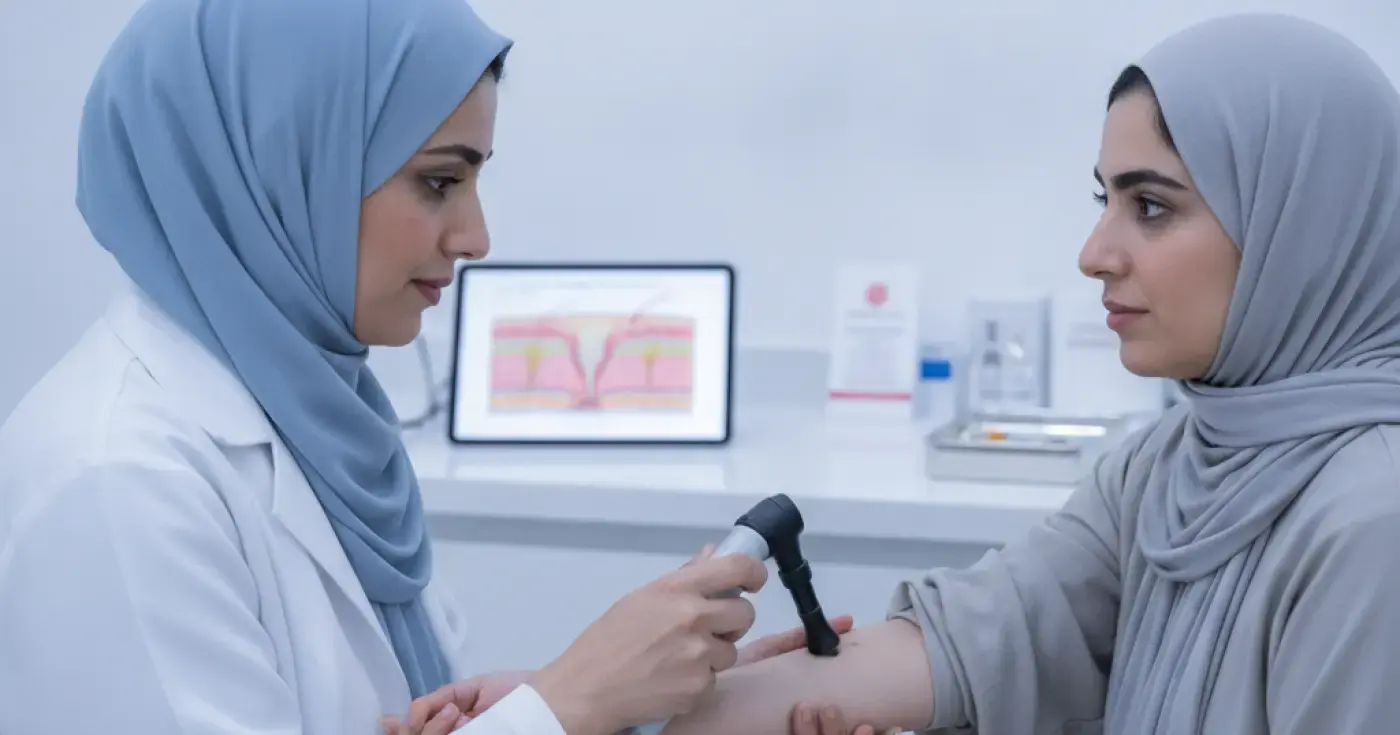
This is a handheld, illuminated magnifying device that allows the dermatologist to see the deeper layers of the skin and the structural arrangement of pigment cells. This painless, non-invasive exam helps distinguish between benign and malignant lesions with high precision.
If the dermatologist suspects any abnormalities during the dermoscopy, they will perform a skin biopsy under local anesthesia. This involves removing all or part of the mole and sending it to a pathology lab to examine the cells under a microscope for a definitive diagnosis.
Based on the clinical and histological findings, the doctor will determine the most appropriate removal method:
This method is used for larger moles or those suspected of being atypical or malignant. The doctor removes the entire mole along with a small margin of healthy skin to ensure all abnormal cells are cleared, then closes the wound with fine sutures.
This is used for raised, non-cancerous moles. Under local anesthesia, the dermatologist uses a small, sharp blade to shave the mole down to skin level without the need for sutures.
Laser mole removal is an excellent cosmetic option for small, flat, and completely benign moles. However, dermatologists strongly advise against using lasers for deep or suspicious moles because the laser beam destroys the tissue, making it impossible to send a sample to the lab for biopsy.
After undergoing mole removal, it is crucial to follow your doctor's instructions to ensure proper healing and minimize scarring:
The decision to remove a mole should never be rushed or based purely on cosmetic desire without a proper medical evaluation. A pre-removal examination is the ultimate safety net that ensures a safe procedure and protects you from overlooking silent skin malignancies. Always consult a board-certified dermatologist and perform regular self-exams to monitor your skin health.
Clear, direct answers
Advertisement
Continue exploring
Learn why moles and skin tags can grow back after removal, the recurrence risks of different methods, and when to see a dermatologist.
Read article
Learn the correct medical steps to care for your skin after mole and skin tag removal. Discover how to accelerate wound healing and prevent scars.
Read article
Discover safe mole removal methods, essential pre-procedure tests, post-care tips, and why you should avoid dangerous home removal remedies.
Read article