
Lahalak Medical PlatformDifferentiate Care
A comprehensive medical guide to benign skin tumors, common types like moles and skin tags, differentiation from cancer, and when to consult a dermatologist.
Advertisement
Benign skin tumors are among the most common dermatological conditions encountered by skin specialists daily. These growths represent non-cancerous proliferations of skin cells that do not invade surrounding tissues or spread to other parts of the body. They present in various shapes, colors, and sizes, and while they are generally harmless, understanding their nature and knowing how to distinguish them from malignant lesions is vital for maintaining skin health.
In Saudi Arabia, public awareness regarding skin health and regular skin checks is steadily rising. This is particularly important given the region's sunny climate, as chronic ultraviolet (UV) exposure can stimulate various skin growths. This comprehensive guide aims to shed light on the most common types of benign skin tumors, their causes, and how they are medically managed.
It is crucial to know how to perform a basic self-assessment of skin growths. Dermatologists worldwide recommend using the ABCDE rule to monitor moles and other skin lesions for early warning signs of skin cancer:
Moles are common skin growths that occur when pigment-producing cells (melanocytes) grow in clusters. They usually appear during childhood and adolescence and can be flat or raised, ranging in color from pink to dark brown or black. While most moles remain benign throughout life, any changes should be monitored closely. In some cases, patients may opt for mole removal for cosmetic or functional reasons.
Seborrheic keratoses are highly common, non-cancerous skin growths that typically appear as people age. They often have a waxy, scaly, or "stuck-on" appearance and range in color from light tan to black. Although their appearance can sometimes mimic skin cancer to the untrained eye, they are completely harmless and non-infectious.
A lipoma is a slow-growing, benign lump of fat cells located just beneath the skin. It feels soft, doughy, and moves easily under light finger pressure. Commonly found on the neck, shoulders, back, or arms, lipomas are generally painless unless they press on adjacent nerves or contain many blood vessels.
Dermatofibromas are small, firm, red-to-brown bumps that most commonly develop on the lower legs. They are composed of fibrous tissue and often arise as an overgrowth reaction to minor skin trauma, such as an insect bite or a nick from shaving. A classic diagnostic sign is the "dimple sign"—the lesion dimples inward when pinched on both sides.
Skin tags are small, soft, flesh-colored growths that hang off the skin by a thin stalk (peduncle). They frequently develop in areas where skin rubs against skin or clothing, such as the neck, armpits, and groin. They are associated with weight gain, friction, and hormonal fluctuations (such as during pregnancy) and are entirely harmless.
Hemangiomas are benign growths made up of an abnormal collection of blood vessels. In adults, "cherry hemangiomas" are very common, appearing as small, bright red, dome-like spots on the trunk or limbs. They can be safely treated using laser therapy for hemangiomas if they cause cosmetic concerns or bleed easily.
| Tumor Type | Typical Appearance | Common Locations | Treatment Necessity |
|---|---|---|---|
| Moles (Nevi) | Flat or raised brown/black spots | Anywhere on the body | None, unless atypical or for cosmetic reasons |
| Seborrheic Keratosis | Waxy, scaly, "stuck-on" growths | Face, chest, back | None, unless irritated or rubbed by clothing |
| Lipomas | Soft, movable fatty lumps under skin | Neck, shoulders, back | Surgical removal if large, growing, or painful |
| Skin Tags | Small, soft, hanging skin growths | Neck, armpits, skin folds | Easily removed if irritated or for cosmetic preference |
| Cherry Hemangiomas | Bright red, small vascular spots | Trunk, abdomen, back | None, easily treated with laser for cosmetics |
The development of benign skin tumors is influenced by a combination of genetic, environmental, and physiological factors:
While benign skin tumors do not pose a direct threat to health, certain warning signs require immediate medical evaluation to rule out malignancy. It is highly recommended to learn self-examination of moles and seek professional advice if you notice:
During a consultation, a dermatologist uses specialized diagnostic tools to evaluate skin lesions safely and accurately:
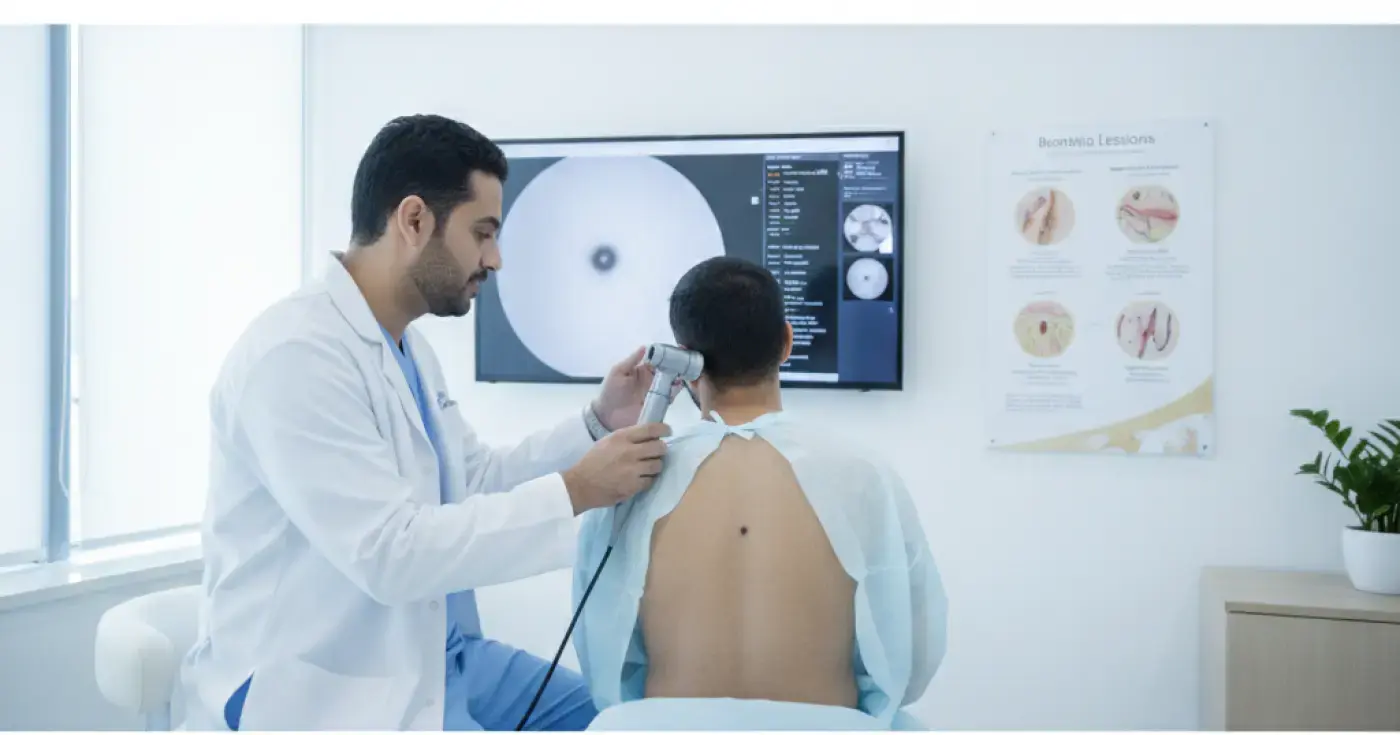
The evaluation begins with a visual inspection using a dermoscope—a specialized handheld magnifying tool with polarized light that allows the doctor to see pigment patterns and vascular structures beneath the skin's surface. If a lesion exhibits atypical features or if there is any diagnostic uncertainty, the dermatologist will perform a skin biopsy. This involves removing a small sample of the tissue under local anesthesia for histopathological analysis in a laboratory to confirm its benign nature.
Most benign skin tumors do not require treatment unless they cause physical discomfort, get caught on clothing, or present cosmetic concerns. Safe clinical removal methods include:
To maintain healthy skin and minimize the development of sun-related skin growths, consider the following preventive measures:
Clear, direct answers
Advertisement
Continue exploring

Learn when a mole requires medical examination before removal, the ABCDE criteria, and safe dermatological procedures to prevent complications.
Read article
Learn why moles and skin tags can grow back after removal, the recurrence risks of different methods, and when to see a dermatologist.
Read article
Learn the correct medical steps to care for your skin after mole and skin tag removal. Discover how to accelerate wound healing and prevent scars.
Read article