
Lahalak Medical PlatformDifferentiate Care
Explore the latest medical breakthroughs for alopecia and hair loss in Saudi Arabia, including approved JAK inhibitors, PRP therapy, and oral minoxidil.
Advertisement
Hair loss, particularly alopecia, is one of the most common dermatological challenges affecting the quality of life and psychological well-being of patients. There are various types of alopecia with different underlying causes, ranging from Alopecia Areata—an autoimmune disorder—to Androgenetic Alopecia (pattern hair loss). For decades, treatment options were limited to managing symptoms using topical or intralesional corticosteroids. However, recent years have witnessed an unprecedented scientific breakthrough that has fundamentally changed how we manage this condition.
In this comprehensive guide prepared for LahaLak medical platform, we highlight the latest medically approved treatments globally and in the Kingdom of Saudi Arabia, focusing on novel mechanisms of action and regenerative technologies that offer promising solutions under the supervision of expert dermatologists.
Janus Kinase (JAK) inhibitors represent the most significant milestone in treating severe alopecia areata. These medications work by targeting specific cellular signaling pathways that contribute to the autoimmune attack on hair follicles, allowing the follicles to recover and resume normal hair growth.
Baricitinib is the first oral JAK inhibitor to receive approval from both the Saudi Food and Drug Authority (SFDA) and the US Food and Drug Authority (FDA) for treating adults with severe alopecia areata. Clinical trials demonstrated its ability to achieve significant hair regrowth on the scalp, eyebrows, and eyelashes in a substantial percentage of patients who did not respond to traditional therapies.
This medication represents another advanced step, approved for treating adults and adolescents aged 12 and older with severe alopecia areata. Ritlecitinib is a selective inhibitor that blocks specific kinase families, reducing immune activity directed against hair follicles while maintaining an acceptable safety profile under continuous medical monitoring.
Despite the remarkable development of JAK inhibitors, traditional treatments continue to play a pivotal role, especially in mild to moderate cases, or as supportive therapies:
Advancements have not been limited to autoimmune alopecia but also cover androgenetic alopecia, which affects both men and women:
Low-dose oral minoxidil (ranging from 0.25 to 5 mg daily) has emerged as a highly effective and convenient alternative for patients who find it difficult to adhere to daily topical minoxidil or who experience scalp irritation. Studies indicate its high efficacy in improving hair density, with the necessity of a cardiovascular and blood pressure evaluation before initiation to avoid minor side effects.
Medications such as Finasteride and Dutasteride remain the cornerstone of treating male pattern hair loss by inhibiting the 5-alpha reductase enzyme responsible for converting testosterone to dihydrotestosterone (DHT), which causes follicle miniaturization. Modern topical formulations of these drugs are now available to minimize systemic absorption and potential side effects.
The following table provides a simplified scientific comparison to help patients understand the available options after obtaining a professional dermatology consultation:
| Treatment Type | Primary Mechanism | Target Group | Key Advantages | Potential Side Effects |
|---|---|---|---|---|
| JAK Inhibitors (Oral) | Inhibits autoimmune inflammatory pathways | Severe Alopecia Areata (Totalis & Universalis) | Excellent results for full hair regrowth | Mild increase in infection risk, lipid profile changes |
| Intralesional Steroid Injections | Reduces local scalp inflammation | Localized Alopecia Areata (small patches) | Simple in-office procedure, rare systemic side effects | Temporary skin atrophy at the injection site |
| Low-Dose Oral Minoxidil | Vasodilation and follicle stimulation | Androgenetic Alopecia and pattern hair loss | Better compliance compared to topical solutions | Mild blood pressure drop, increased body hair (hypertrichosis) |
| Platelet-Rich Plasma (PRP) | Nourishes follicles with natural growth factors | Androgenetic Alopecia and thinning hair | Highly safe as it is derived from the patient's own blood | Temporary scalp soreness immediately after injection |
In addition to pharmacological treatments, supportive technologies have evolved significantly to offer integrated solutions for hair loss patients:
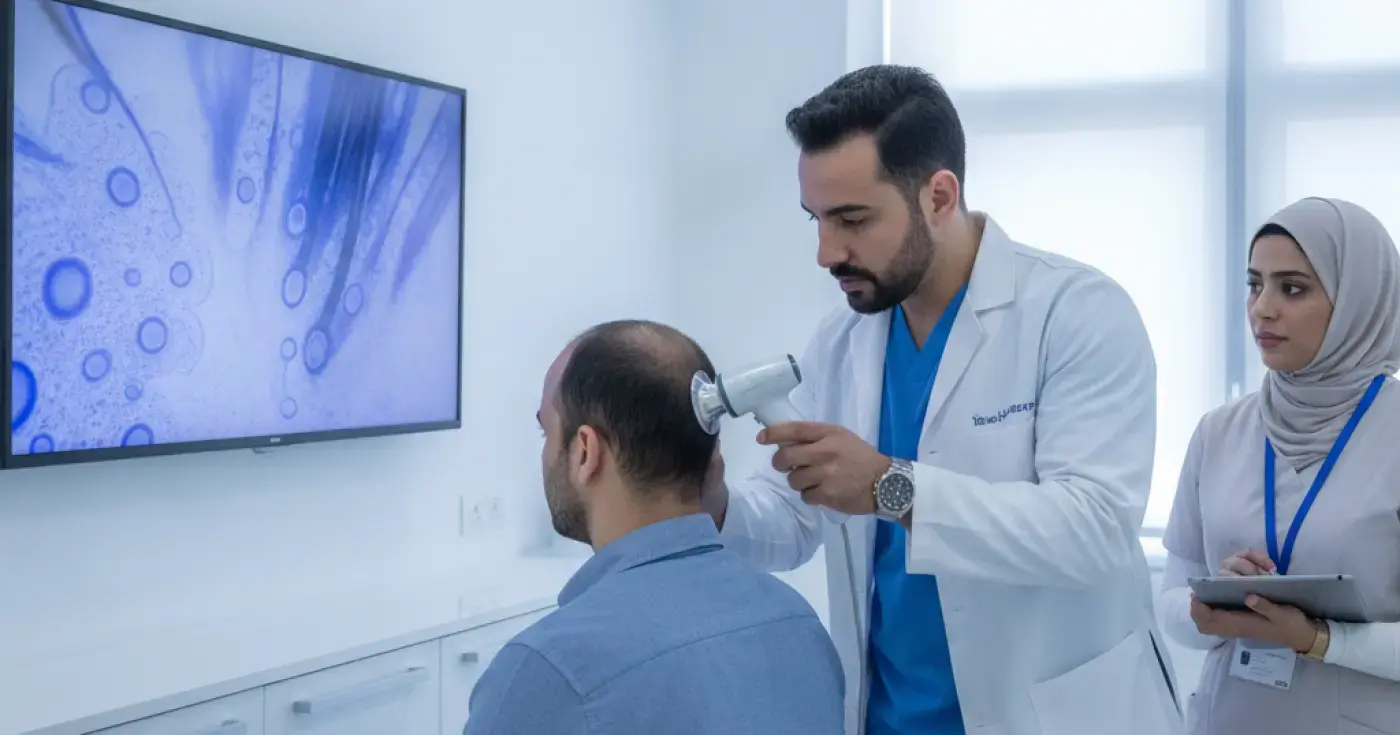
No advanced treatment plan can begin without an accurate diagnosis that determines the specific type and cause of hair loss. Modern clinical examinations include:
While modern treatments are highly effective, they require caution and precise medical supervision. For instance, JAK inhibitors necessitate periodic blood tests to monitor liver and kidney functions, lipid levels, and blood cell counts. Patients must also discuss their complete medical history with their treating physician, including any history of chronic infections such as tuberculosis or hepatitis.
LahaLak medical platform provides essential guidelines to ensure a safe and successful treatment journey:
Clear, direct answers
Advertisement
Continue exploring
Explore the connection between vitamin deficiencies and alopecia areata. Learn about essential tests, medical treatments, and nutritional support.
Read article
A comprehensive guide on the psychological effects of alopecia, coping mechanisms for anxiety, and practical ways to rebuild self-confidence.
Read article
Learn about the importance of early alopecia diagnosis and the key medical tests and blood panels used to identify hair loss types.
Read articleExplore the topic