
Lahalak Medical PlatformDifferentiate Care
Learn the clinical differences between alopecia areata and general hair loss, including causes, symptoms, diagnosis, and medical treatments.
Advertisement
Hair is an essential part of human identity and aesthetic health, and changes in its density or loss can be a major source of concern. Physiologically, hair goes through a natural growth cycle consisting of three main phases: the growth phase (Anagen), the transitional phase (Catagen), and the resting phase (Telogen). Under normal conditions, a person loses between 50 to 100 hairs per day as part of this natural cycle of cell renewal.
However, when hair loss exceeds this rate, or when it appears as distinct bald patches, we are facing a medical condition that requires evaluation. Here, a common confusion arises between two completely different medical concepts: general hair loss and alopecia areata. This comprehensive medical guide aims to clarify the precise clinical differences between the two conditions to help you understand the nature of the problem and guide you toward the correct treatment.
General hair loss is a broad umbrella term that includes several types of hair shedding that lead to a gradual thinning of the scalp without the presence of completely bald, smooth circular patches. Among the most prominent types of general hair loss are:
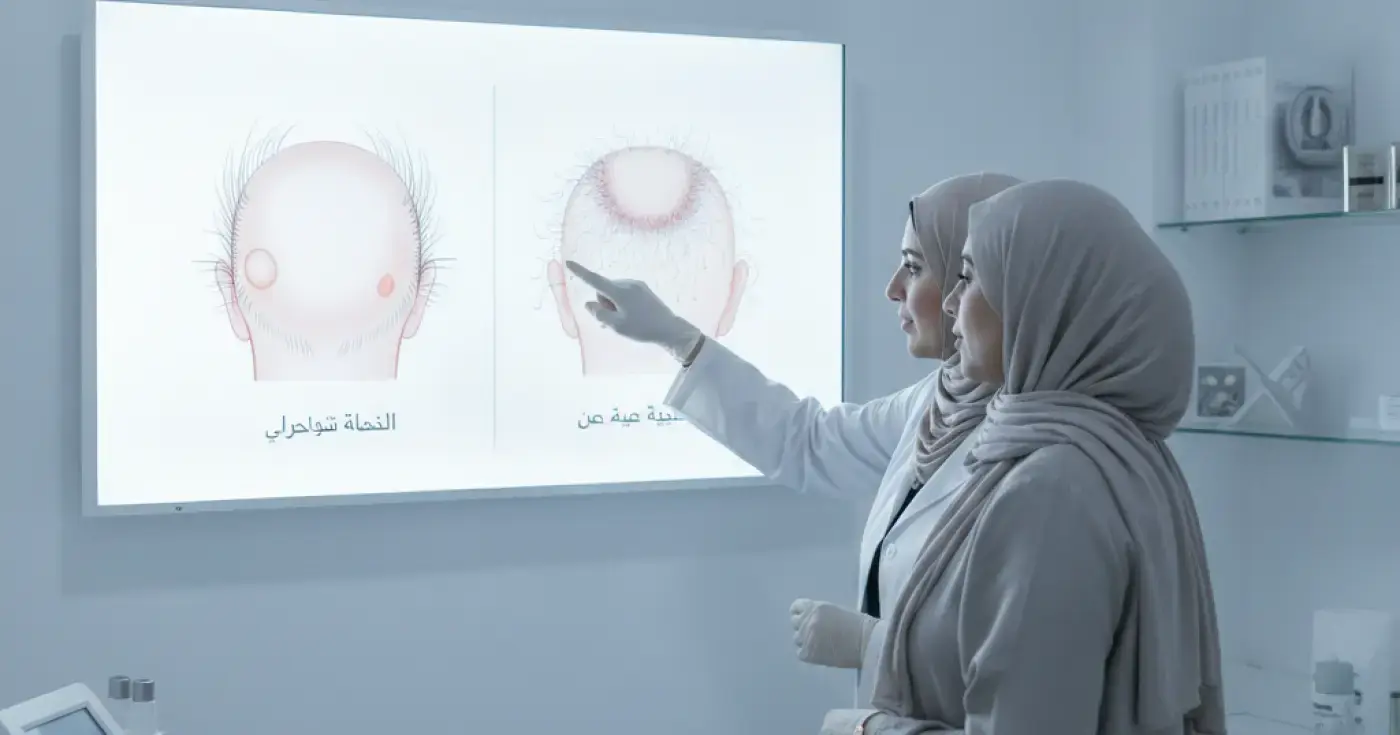
In contrast to general shedding, alopecia areata is a specific autoimmune disease. In this condition, the body's immune system mistakenly attacks the hair follicles, weakening them and stopping them from producing new hair. Alopecia is characterized by the sudden appearance of smooth, completely hairless circular or oval patches on the scalp, beard, eyebrows, or any other hair-bearing area of the body. In rare cases, alopecia can progress to involve the entire scalp (Alopecia Totalis) or the entire body (Alopecia Universalis).
To facilitate understanding, the following table summarizes the fundamental differences between the two conditions:
| Feature | General Hair Loss | Alopecia Areata |
|---|---|---|
| Pathology | Hormonal, genetic, environmental, or nutritional factors affecting the hair growth cycle. | An autoimmune disorder where the immune system directly attacks hair follicles. |
| Clinical Presentation | Diffuse thinning and gradual reduction in hair density without smooth bald patches. | Well-defined circular or oval patches that are completely smooth and hairless. |
| Onset Speed | Gradual and slow, taking months or years (except for Telogen Effluvium). | Sudden and very rapid, with patches appearing within days. |
| Affected Areas | Primarily and uniformly across the scalp. | Any hair-bearing area of the body (scalp, beard, eyebrows, eyelashes). |
| Genetic Factor | Very strong in pattern baldness. | Present, but also linked to other autoimmune diseases like vitiligo and thyroid disorders. |
During a clinic visit, a specialist dermatologist will perform a thorough evaluation, including:
Advanced and approved treatment options by the Saudi Food and Drug Authority (SFDA) are available in dermatology clinics across Saudi Arabia:
It is highly recommended to seek a dermatologist consultation immediately if you experience:
Although autoimmune alopecia cannot be fully prevented, adopting a healthy lifestyle can reduce the severity of general hair loss and support follicle health:
Clear, direct answers
Advertisement
Continue exploring
Discover the early signs of androgenetic alopecia in men and women, and explore the best clinically proven treatments and management options.
Read article
Learn why postpartum hair loss happens, when it starts and ends, and the best medical and home care tips to restore your hair health safely.
Read article
Learn how vitamin and mineral deficiencies cause hair loss, the key nutrients for hair follicle health, and when to consult a dermatologist.
Read articleExplore the topic