
Lahalak Medical PlatformDifferentiate Care
Learn how the stool Ova and Parasites (O&P) test works, proper sample collection steps, accuracy limits, PCR vs microscopic testing, and when to seek care.
Advertisement
The stool ova and parasites test (O&P) is a standard laboratory diagnostic examination designed to detect parasites, their cysts, or their eggs (ova) in the gastrointestinal tract. Physicians commonly request this test when patients experience persistent watery or mucous diarrhea, abdominal cramps, severe bloating, or unexplained weight loss—particularly after recent international travel or exposure to untreated water sources.
However, it is crucial to recognize that a traditional microscopic O&P test has specific clinical limitations. A single negative result does not completely rule out parasitic infection nor explain all causes of persistent diarrhea, which may stem from bacterial pathogens, viruses, or non-infectious inflammatory disorders.
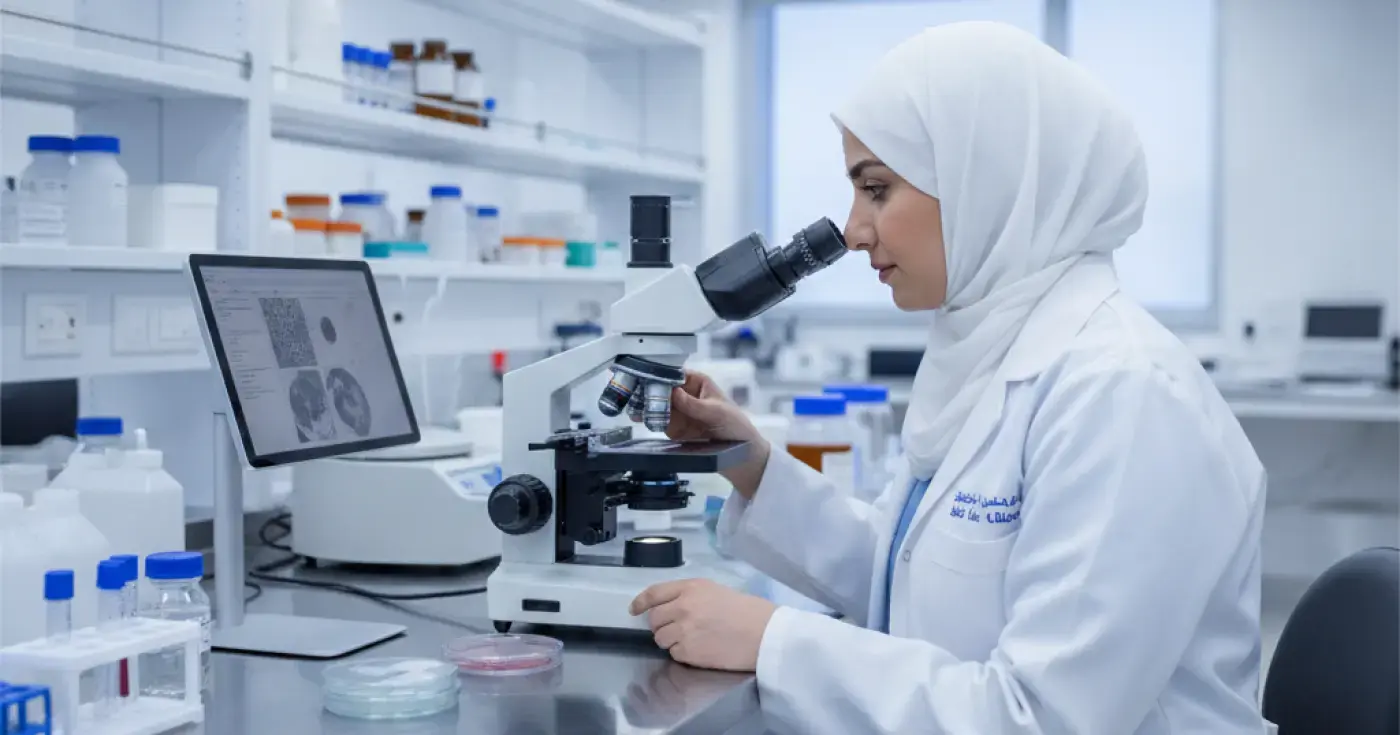
The O&P exam is a fundamental microbiology test. A laboratory technician prepares and stains a stool sample on a microscopic slide to search for single-celled protozoa or multicellular helminths (worms) and their reproductive forms.
Intestinal parasites generally exist in two main forms: the active, motile stage known as a trophozoite, and the dormant, resistant stage known as a cyst or egg (ova). Cysts feature protective walls, enabling them to survive outside the host body. The O&P exam aims to identify these specific forms to establish an accurate diagnosis.
Healthcare providers order a stool test for parasites when patient history and clinical presentation point toward a potential intestinal infection. Common indications include:
While valuable, traditional microscopic O&P analysis cannot detect every parasite species with equal efficiency. Detection limits depend on parasite size, concentration in the specimen, and technical expertise.
Microscopic organisms such as Cryptosporidium, Cyclospora, or Microsporidia require specialized staining methods or fluorescent antibody techniques. Furthermore, organisms attached tightly to the small intestinal lining may shed cysts sporadically, reducing detection probability in a single stool sample.
It is standard clinical practice to request three stool specimens collected on separate days within a 7- to 10-day window. This requirement accounts for intermittent shedding—the non-continuous passage of parasites and eggs into the stool stream.
Clinical studies demonstrate that analyzing a single stool specimen detects approximately 50% to 60% of parasitic infections, whereas examining three properly collected serial specimens increases diagnostic yield to over 90%.
Proper specimen collection is critical for accurate diagnostic results. Follow these essential guidelines:
Prepare the Container: Use only the sterile, leak-proof container provided by the laboratory. Do not use household jars or unsterilized plastic boxes.
Several external and physiological factors can interfere with stool parasite analysis, leading to potential false-negative results:
| Interfering Factor | Impact on O&P Test | Recommended Action |
|---|---|---|
| Antibiotics / Antifungals | Temporarily reduces parasite counts in the gut | Delay sample collection 2–3 weeks post-treatment if advised by the doctor |
| Barium Sulfate Contrast | Obscures microscopic field with opaque crystals | Wait at least 7–10 days after barium imaging procedures. |
| Antacids & Laxatives | Alters stool pH and morphology; mineral oil distorts field | Avoid oily laxatives or antacids before sample collection. |
| Urine or Water Contamination | Destroys fragile trophozoites; tap water introduces free-living amoebae | Strictly separate urine and flush water during collection. |
A positive result indicates that parasites, cysts, or ova were successfully identified under the microscope. The report usually specifies the exact organism identified, such as Giardia duodenalis, Entamoeba histolytica, or Cryptosporidium spp.
Identification of a pathogen enables your healthcare provider to select targeted, evidence-based antimicrobial or antiparasitic therapy. It is essential to complete the prescribed therapeutic course even if symptoms improve early.
A negative report means no parasites or eggs were detected in the examined specimen. However, if gastrointestinal symptoms continue, a negative O&P result does not eliminate the need for further clinical evaluation.
Your doctor may consider alternative diagnoses, such as bacterial gastroenteritis, viral infection, irritable bowel syndrome (IBS), small intestinal bacterial overgrowth (SIBO), or inflammatory bowel disease. Advanced testing, including molecular PCR panels or a primary care or gastroenterology consultation, may be warranted.
['Higher cost; requires specialized laboratory equipment']
| Diagnostic Method | Sensitivity & Speed | Key Advantages | Primary Limitations |
|---|---|---|---|
| Microscopic O&P | Moderate sensitivity; manual examination | Broad screen for various visible parasites and eggs | Requires an expert microscopist; affected by intermittent shedding |
| Antigen Testing (EIA/ELISA) | High sensitivity for targeted species | Rapid detection of specific antigens (e.g., Giardia) | Detects only pre-specified single-target pathogens |
| Stool PCR Panel | Very high sensitivity; rapid automated results | Detects low DNA levels; unaffected by organism viability |
While many parasitic infections cause mild to moderate illness, severe complications can arise. Seek emergency clinical evaluation if you observe any of the following warning signs:
Clear, direct answers
Advertisement
Continue exploring
Learn when oral thrush requires a fungal swab or culture, the causes of white spots and mouth burning, and how to differentiate candidiasis from other conditions.
Read article
Learn about recurrent vaginal yeast infections, causes of itching and discharge, vaginal swab tests, fungal cultures, and when to consult a specialist.
Read article
Discover signs of scalp ringworm in children, how it differs from alopecia and dandruff, and the role of fungal microscopic testing and culture.
Read articleExplore the topic