
Lahalak Medical PlatformDifferentiate Care
Compare in-person and virtual hair transplant consultations. Discover the pros, cons, and clinical criteria to choose the best option for you.
Advertisement
A hair transplant is a significant medical and aesthetic procedure that requires meticulous planning and a deep understanding of the scalp's condition. This journey always begins with a medical consultation, which determines the patient's candidacy, the most suitable technique, and the expected outcomes. With the rapid digital transformation in healthcare, a key question has emerged: Is it better to have an in-person consultation at the clinic, or is a remote online consultation sufficient?
This comprehensive medical article aims to highlight the fundamental differences between in-person and virtual consultations, explaining the clinical pros and cons of each to help you make an evidence-based decision.
An in-person consultation remains the gold standard in pre-operative evaluation. During this session, the physician performs a direct clinical examination of the scalp, which is crucial for the success of the procedure. Direct examination allows the doctor to assess skin elasticity, hair shaft thickness, and the density of the donor area (the back and sides of the head) from which the grafts will be harvested.
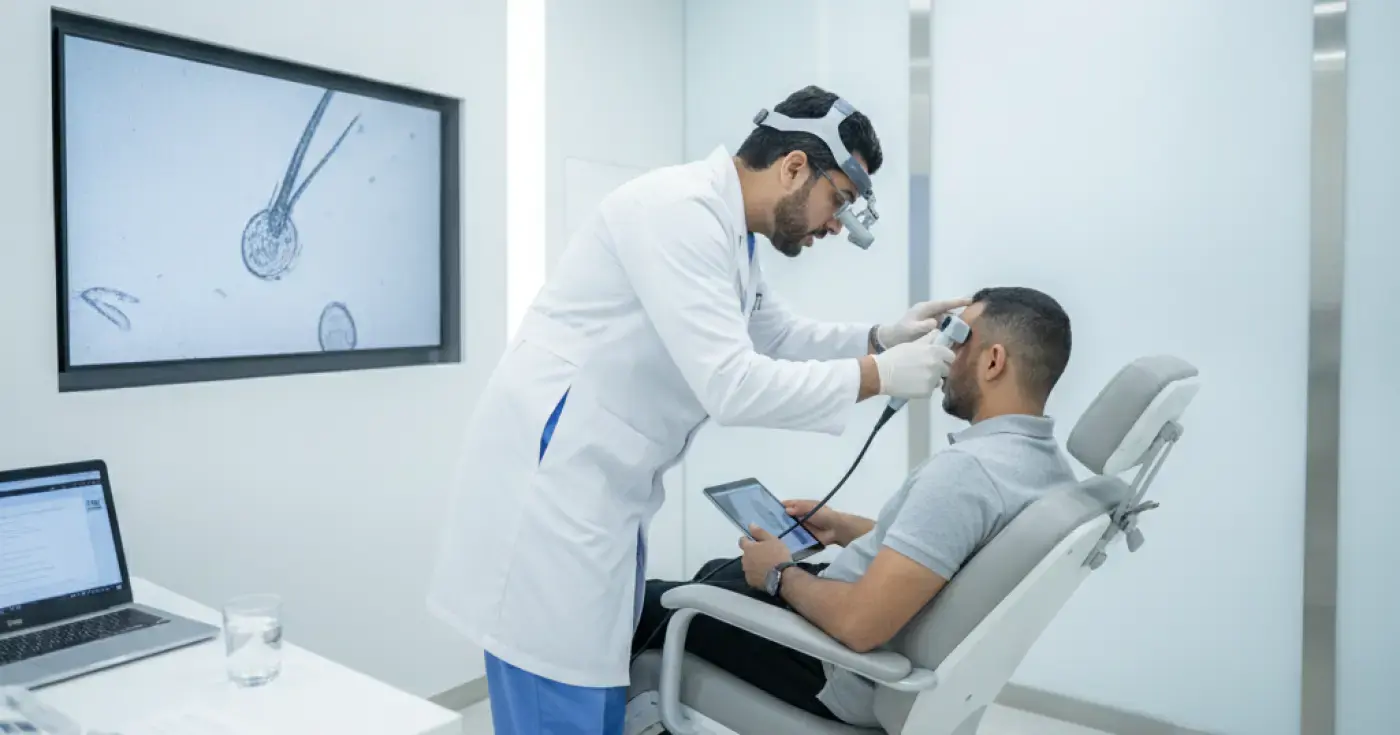
In the clinic, the physician uses specialized diagnostic tools such as a trichoscope (hair loss scale and imaging tool). This device magnifies the scalp and hair follicles hundreds of times, allowing the doctor to see crucial details like the number of hairs per follicular unit and the presence of any scalp inflammation or dermatological conditions that might preclude surgery.
A face-to-face meeting fosters a strong relationship of trust between the patient and the surgeon. Patients can address their concerns directly, observe the clinic's hygiene and medical standards, and review real before-and-after cases treated at the same facility.
Cons: In-person consultations require dedicated travel and waiting time, and can be financially and logistically demanding if the preferred specialist is located in another city or outside Saudi Arabia.
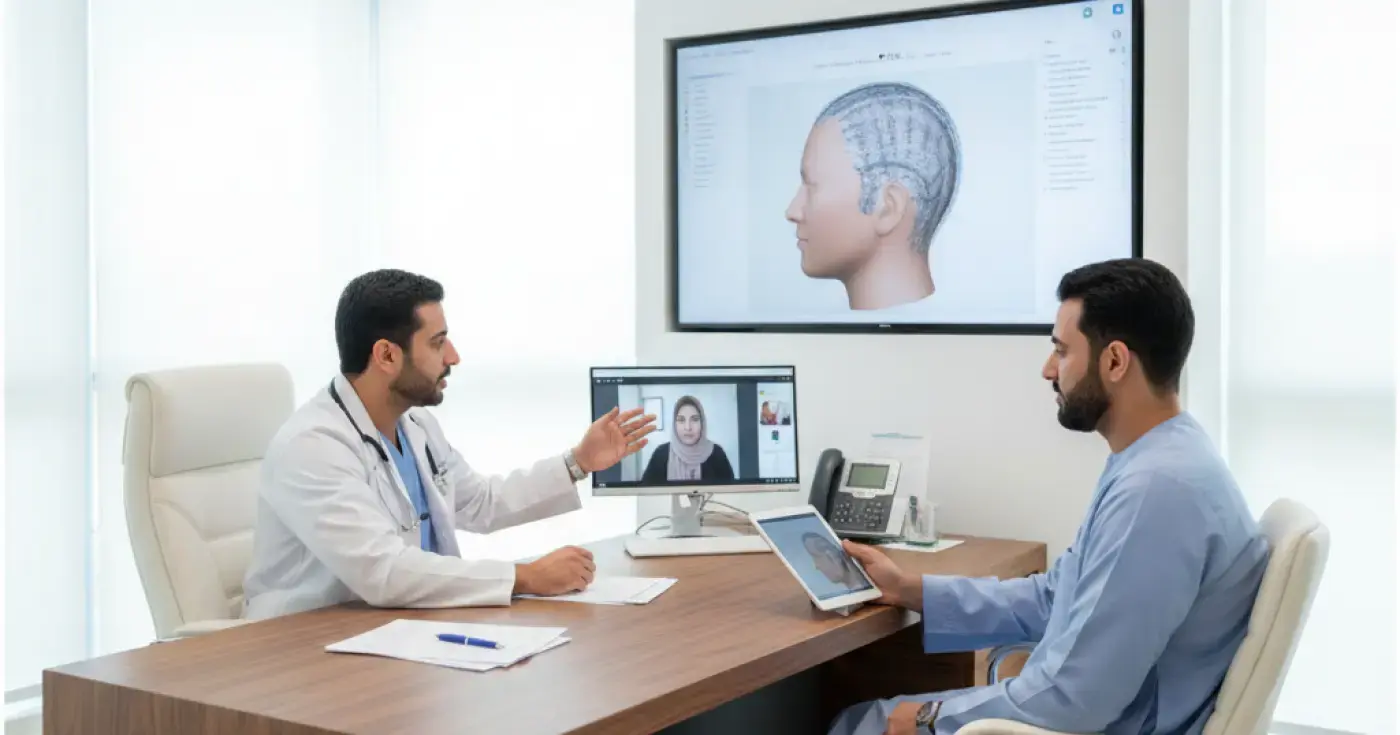
Virtual consultations offer high flexibility and ease of scheduling. This technology allows patients to connect with top specialists locally and globally without the need to travel, saving significant time, effort, and logistical costs during the initial research phase.
Despite its convenience, a remote consultation has clear clinical limitations. It relies entirely on photos and videos provided by the patient. These images may not accurately represent the quality of the donor area or the scalp's true condition due to variations in lighting or camera angles. Furthermore, microscopic evaluation of the hair follicles is impossible.
Cons: The inability to perform a physical examination means that the initial online assessment is only tentative. Discrepancies may arise on the day of the procedure, potentially forcing the surgeon to modify the treatment plan or the estimated graft count.
The following table provides a detailed comparison between in-person and remote hair transplant consultations:
| Feature | In-Person Clinic Consultation | Remote Virtual Consultation | |||
|---|---|---|---|---|---|
| Donor Area Assessment | Highly accurate (direct clinical & microscopic exam) | Approximate (dependent on photo/video quality) | Graft Count Estimation | Highly precise and confirmed | Estimated and subject to change on surgery day |
| Scalp Pathology Detection | Reliable using diagnostic tools | Difficult; subtle conditions may be missed | |||
| Hairline Designing | Drawn and adjusted directly on the scalp | Preliminary and virtual design only | |||
| Cost and Logistics | Requires travel, waiting, and higher fees | Flexible, quick, and often low-cost or free | |||
| Primary Objective | Final decision-making and surgical planning | Initial screening and obtaining a second opinion |
To determine the best option for your situation, medical experts recommend considering the following criteria:
Whether you choose an in-person or virtual session, the consultation typically involves:
Ultimately, a remote consultation cannot fully replace an in-person evaluation when it comes to making the final surgical decision. The ideal clinical approach is to combine both: start with a remote consultation to gather initial information, estimate costs, and discuss the general plan. However, always ensure you undergo a thorough, direct physical examination with your operating surgeon prior to the procedure to guarantee precise planning, safety, and optimal results.
Clear, direct answers
Advertisement
Continue exploring
Learn how hair transplant consultations determine the exact number of grafts needed based on your donor area, hair loss stage, and goals.
Read article
Discover the essential blood tests, scalp evaluations, and clinical assessments required before undergoing a hair transplant for optimal safety.
Read article
Discover female hair transplant suitability, advanced techniques, pre-op tests, and expected results for a natural, fuller look.
Read articleExplore the topic