
Lahalak Medical PlatformDifferentiate Care
Learn if benign skin lesions can become cancerous, discover the ABCDE warning signs, and understand when to consult a dermatologist.

Advertisement
Skin growths are among the most common reasons for visiting dermatology clinics. While the vast majority of these lesions are benign and harmless, a frequent question patients ask is: Can these benign skin tumors turn malignant? Understanding this requires a precise clinical perspective to differentiate between various skin lesions, knowing when to seek medical evaluation and when to be reassured.
Clinically, benign skin tumors refer to non-cancerous growths of skin cells that lack the ability to invade neighboring tissues or spread to other organs. However, some lesions that appear benign may carry a risk of malignant transformation, or they may closely mimic malignant tumors, making an accurate diagnosis through a dermatologist consultation essential for safety.
Benign skin tumors present in various forms depending on their cell of origin. Some of the most common types include:
The precise scientific answer is that the vast majority of true benign skin tumors, such as seborrheic keratoses, lipomas, and cherry angiomas, never transform into malignant tumors. These cells possess a stable genetic profile that prevents them from becoming invasive.
However, there are important exceptions to be aware of:
Some skin lesions are not fully malignant but are not entirely benign either; these are known as precancerous lesions. The most prominent example is Actinic Keratosis. These present as rough, scaly patches on sun-exposed areas like the face and hands. If left untreated, a percentage of these lesions can progress to squamous cell carcinoma over time.
While ordinary moles rarely turn into melanoma (a serious form of skin cancer), atypical moles—which are larger, have irregular borders, and display multiple colors—carry a higher risk of transforming into melanoma or serve as markers for an increased overall risk of developing skin cancer.
The following table outlines the key differences between common skin lesions and their risk of malignant transformation:
| Lesion Type | Common Clinical Appearance | Malignant Transformation Risk | Recommended Medical Action |
|---|---|---|---|
| Seborrheic Keratosis | Waxy, scaly, brown or black "stuck-on" appearance | Zero | Observation, or removal if irritated or for cosmetic reasons |
| Common Moles | Symmetrical, round, uniform color, well-defined borders | Extremely Low | Routine self-monitoring |
| Actinic Keratosis | Rough, dry, scaly patches on sun-exposed skin | Moderate (can progress to Squamous Cell Carcinoma) | Prompt treatment via cryotherapy or topical creams |
| Atypical Moles | Irregular borders, multiple colors, larger than 6 mm | Low to Moderate (requires caution) | Regular clinical monitoring and skin biopsy if suspicious |
To facilitate self-monitoring of moles, dermatologists developed the ABCDE criteria to help patients identify suspicious changes that may indicate malignant transformation or melanoma:
Several factors can increase the likelihood of skin lesions developing or transforming into skin cancers:
When visiting a dermatologist to evaluate a concerning skin lesion, several diagnostic steps are typically followed:
The physician will examine the lesion using a dermoscope, a specialized magnifying tool that allows visualization of deeper skin structures. A dermoscopy examination helps distinguish benign patterns from those requiring immediate intervention.
If the dermatologist suspects any atypical activity or potential malignancy, they will perform a skin biopsy under local anesthesia. The tissue sample is sent to a pathology lab for microscopic analysis, which is the definitive method to confirm or rule out cancer.
Prevention is the most effective defense against skin cancer. Given the sunny climate of Saudi Arabia, the following practices are highly recommended:
Clear, direct answers
Advertisement
Continue exploring

Learn about benign skin lumps, common types like lipomas and cysts, and the warning signs that require an immediate visit to a dermatologist.
Read article
Learn about subcutaneous lipomas (benign fatty lumps), their causes, how they are diagnosed, and the latest surgical and non-surgical removal options.
Read article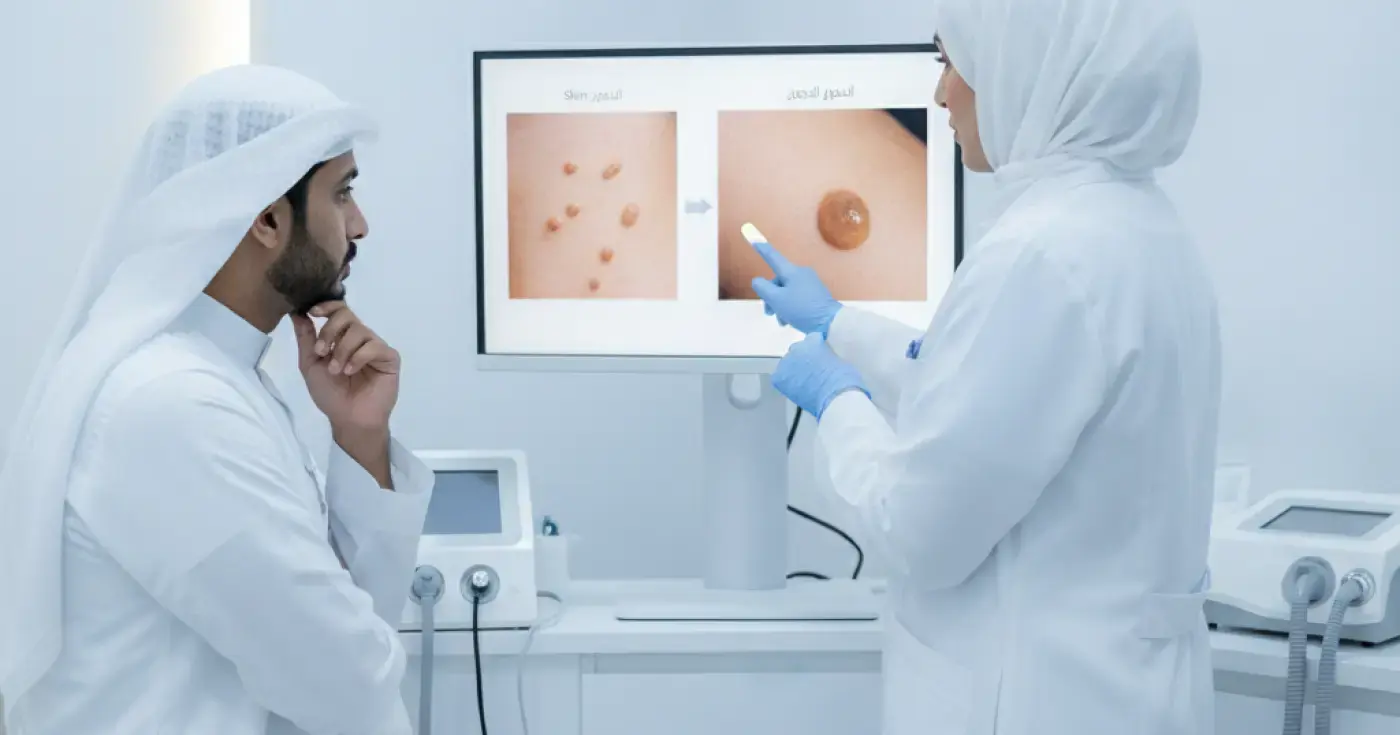
Understand the differences between skin tags and benign skin tumors. Learn about symptoms, causes, removal methods, and when to see a dermatologist.
Read article