
Lahalak Medical PlatformDifferentiate Care
Discover the clinical differences between HIFU ultrasound skin tightening and a surgical facelift. Learn which procedure is best for your skin laxity.
Advertisement
As we age, our skin undergoes natural physiological changes that lead to a loss of elasticity and the appearance of sagging. This is primarily due to a decline in the production of collagen and elastin, the two essential proteins responsible for maintaining skin structure and youthfulness. In the past, the only highly effective solution for addressing deep facial sagging was to undergo complex surgical procedures. However, with the rapid evolution of aesthetic medicine, non-invasive alternatives have emerged to restore skin youthfulness with minimal downtime and risk.
Among these advanced technologies, HIFU technology (High-Intensity Focused Ultrasound) stands out as a leading non-surgical option. Many patients in aesthetic clinics across Saudi Arabia frequently ask: Can ultrasound skin tightening truly replace a surgical facelift? To answer this question objectively, we must explore how each procedure works, their expected outcomes, and their fundamental differences.
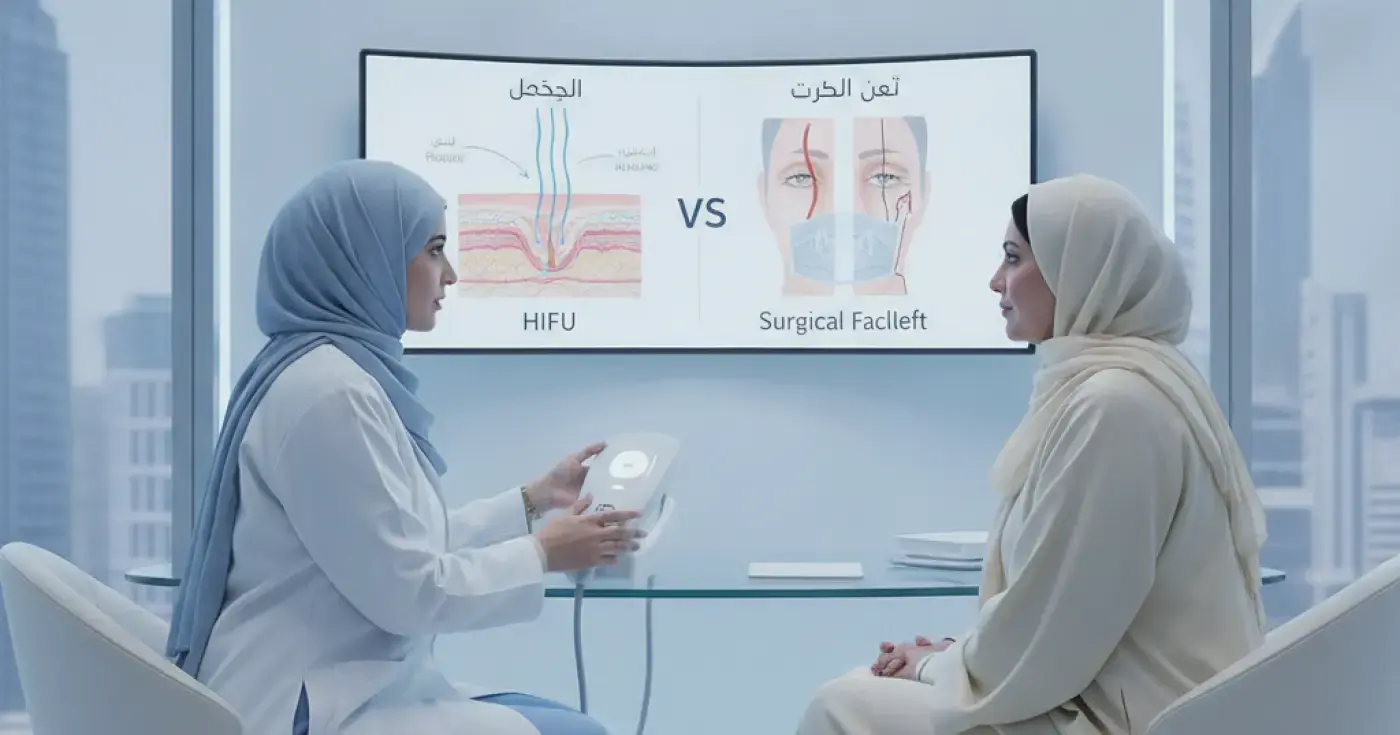
HIFU is a non-invasive treatment that delivers focused ultrasound energy to precise depths beneath the skin without damaging the outer surface (epidermis). This energy penetrates deep into the subcutaneous tissue, specifically targeting the Superficial Muscular Aponeurotic System (SMAS) layer—the very same layer that plastic surgeons manipulate and lift during a traditional surgical facelift.
When focused ultrasound energy reaches this target layer, it generates precise thermal coagulation points. This thermal effect triggers the body's natural healing response, causing immediate contraction of collagen fibers and stimulating the production of fresh collagen over the following months. This gradual process lifts and tightens the tissues of the face and neck, improving the definition of the jawline naturally.
A surgical facelift (rhytidectomy) is an invasive cosmetic procedure designed to reshape and rejuvenate the lower two-thirds of the face and neck. The procedure involves making discreet incisions, typically along the hairline and around the ears. Through these incisions, a plastic surgeon lifts the deep facial tissues, repositions the SMAS layer, removes excess sagging skin, and redistributes or suctions fat to create a more defined, youthful contour.
Surgery remains the gold standard and the most effective solution for severe skin laxity and deep wrinkles that non-surgical treatments cannot adequately address. Facelifts are performed under general anesthesia or deep local sedation and require a dedicated recovery period for optimal healing.
To help you understand the key differences and make an informed decision, the table below provides a comprehensive medical comparison between ultrasound skin tightening and surgical intervention:
| Comparison Feature | Ultrasound Skin Tightening (HIFU) | Surgical Facelift (Rhytidectomy) |
|---|---|---|
| Procedure Type | Non-invasive, completely topical | Invasive surgical procedure |
| Anesthesia | None or mild topical numbing cream | General anesthesia or deep sedation |
| Target Layer | Reaches the SMAS layer via thermal energy | Manually lifts the SMAS and removes excess skin |
| Downtime | Zero downtime (immediate return to daily activities) | 2 to 4 weeks for initial swelling and bruising to subside |
| Results Timeline | Gradual (starts at 2-3 months, peaks at 6 months) | Immediate once swelling subsides (settles in 1-3 months) |
| Longevity of Results | 12 to 18 months (requires periodic maintenance) | Lasts 10 to 15 years depending on skin quality and lifestyle |
| Potential Side Effects | Temporary redness, mild swelling, transient tingling | Scarring, bruising, swelling, infection risks, anesthesia risks |
| Ideal Skin Laxity | Mild to moderate sagging | Moderate to severe sagging with excess skin |
The precise clinical answer is: No, HIFU is not a direct replacement for surgery. Instead, it is an excellent preventative and therapeutic alternative for a specific group of patients. No non-surgical device can match the dramatic capability of surgery to physically excise large amounts of excess skin or manually tighten highly lax muscles.
However, non-surgical facelift options using HIFU serve as an outstanding alternative in the following scenarios:
Choosing the right procedure depends heavily on a clinical evaluation. Here is a breakdown of the ideal candidates for each option:
Clear, direct answers
Advertisement
Continue exploring

Compare HIFU and laser face lifting. Learn about target depths, clinical efficacy, recovery times, and how to choose the right treatment.
Read article
Learn how High-Intensity Focused Ultrasound (HIFU) works for non-surgical skin tightening, its benefits, side effects, and when results appear.
Read article