
Lahalak Medical PlatformDifferentiate Care
Everything you need to know before your first full body laser hair removal session. Learn about laser types, preparation, post-care, and safety protocols.

Advertisement
In recent years, laser hair removal has become one of the most sought-after cosmetic procedures globally and within Saudi Arabia. Transitioning from traditional hair removal methods to a full body laser treatment is an excellent investment in long-term skin smoothness. However, achieving optimal clinical outcomes while minimizing potential side effects requires a thorough understanding of how the technology works, proper pre-session preparation, and strict adherence to post-treatment care.
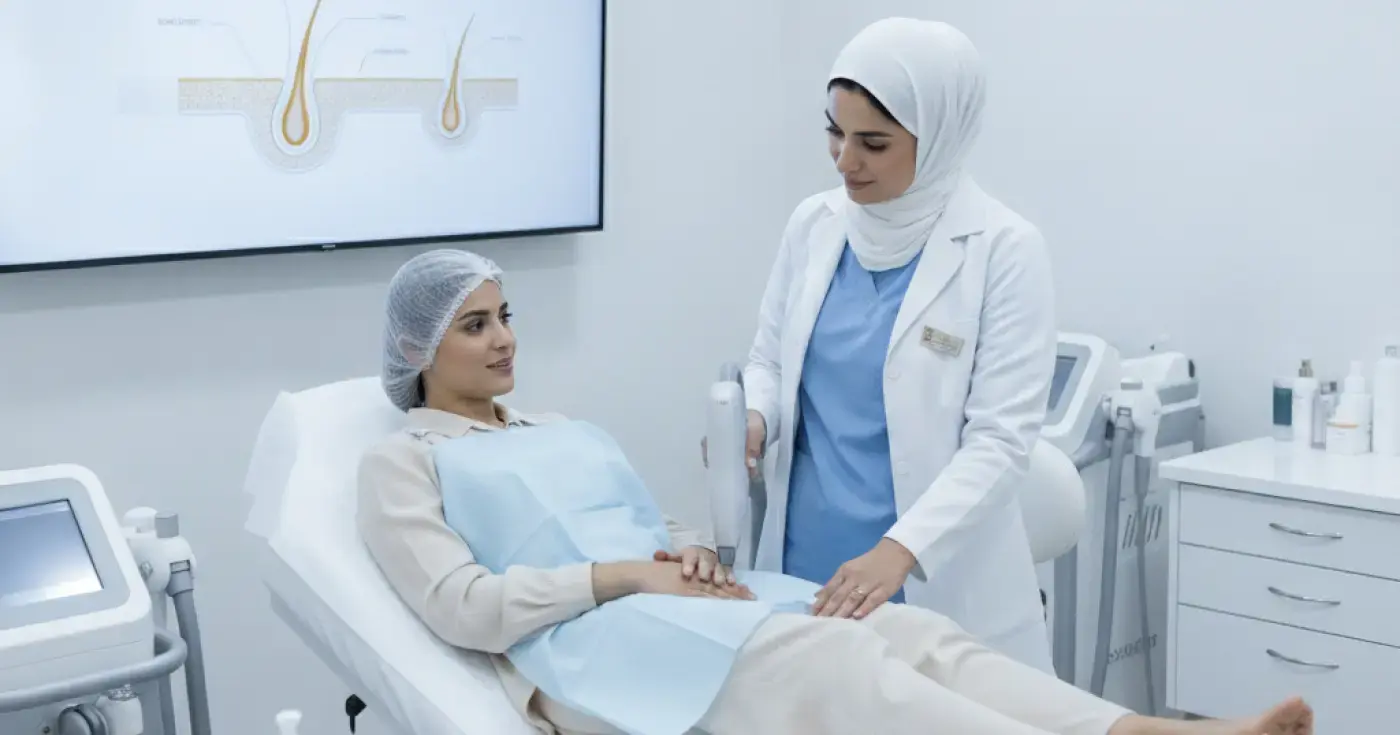
Laser hair removal operates on the principle of selective photothermolysis. The laser device emits a concentrated beam of light at a specific wavelength, which is preferentially absorbed by the pigment (melanin) in the hair shaft and follicle. This light energy is converted into thermal energy, heating and damaging the hair follicle to inhibit future hair growth, while leaving the surrounding skin tissue unharmed.
Hair growth occurs in three distinct phases: anagen (active growth), catagen (transition), and telogen (resting). The laser is highly effective only on hair follicles currently in the active anagen phase. Because not all hairs are in the same phase simultaneously, a series of treatment sessions spaced several weeks apart is clinically necessary to target all follicles as they enter the active growth stage.
Modern dermatological clinics utilize several types of FDA and SFDA-approved laser systems, selected based on the patient's skin type (Fitzpatrick Skin Phototype scale) and hair characteristics:
| Laser Type | Wavelength | Ideal Skin Type | Target Hair Type | Safety Profile for Dark Skin |
|---|---|---|---|---|
| Alexandrite | 755 nm | Fair to Medium | Coarse and Dark | Low to Moderate (Requires caution) |
| Diode | 808 nm | All Skin Types | Fine to Coarse | High |
| Nd:YAG | 1064 nm | Dark to Deeply Pigmented | Deep and Coarse | Very High and Extremely Safe |
Proper preparation is critical to ensure both the safety of your skin and the efficacy of the laser treatment. Follow these clinical guidelines before your first session:
Upon arrival, a trained clinical practitioner will assess your skin and hair type to calibrate the laser settings. The procedure involves the following steps:
Post-session care is vital to prevent complications such as superficial burns, irritation, or hyperpigmentation. Implement proper post-laser skin care by following these steps:
Some temporary side effects are normal and typically resolve within a few hours to a couple of days:
In rare instances, improper settings or failure to follow pre/post-care instructions can lead to blistering, burns, or pigmentary changes. If you experience severe pain, blistering, or unusual skin changes, seek immediate dermatologist consultation.
Because hair grows in cycles, a single session cannot target all follicles. Most patients require 6 to 8 sessions to achieve optimal hair reduction (typically an 80-90% reduction in hair growth). Sessions are spaced 4 to 6 weeks apart for upper body areas (face, underarms) and 6 to 8 weeks apart for lower body areas (legs, bikini line).
Following the initial course, periodic touch-up sessions (usually once or twice a year) are recommended to maintain long-term results and manage any fine hair regrowth triggered by hormonal fluctuations.
While laser hair removal is highly safe, certain conditions require postponing the treatment or obtaining clearance from a physician:
Clear, direct answers
Advertisement
Continue exploring
Learn the essential medical guidelines before and after full-body laser hair removal to prevent burns, hyperpigmentation, and maximize results safely.
Read article
Can you combine laser hair removal with peels, Botox, or retinoids? Discover safe intervals, clinical risks, and expert tips to protect your skin.
Read article
Discover the clinical benefits of steam facials and blackhead removal. Learn safe extraction methods, risks, and post-care tips.
Read article