
Lahalak Medical PlatformDifferentiate Care
Discover the clinical benefits of Platelet-Rich Plasma (PRP) for skin freshness, collagen production, and scar treatment. Read our expert guide.
Advertisement
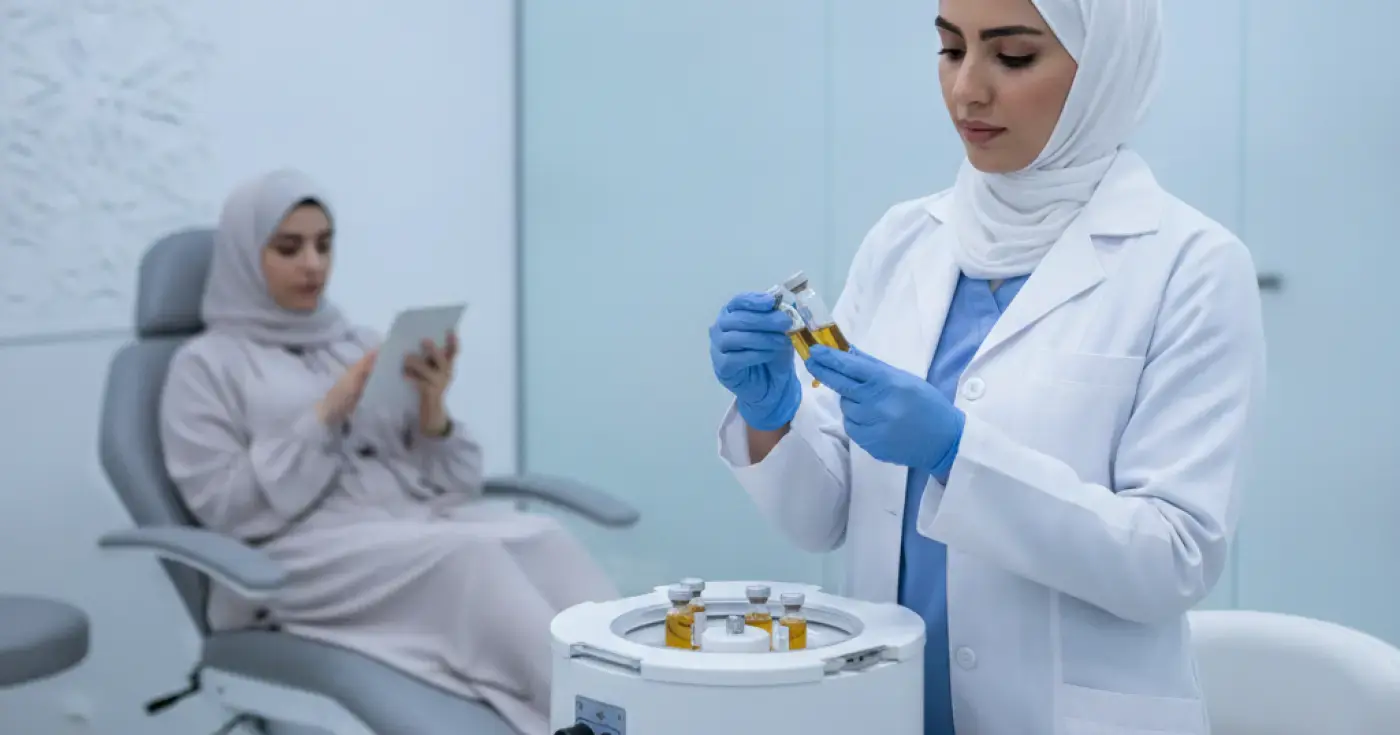
Platelet-Rich Plasma (PRP) therapy has emerged as one of the most innovative, non-surgical advancements in aesthetic dermatology. This autologous treatment harnesses the body's natural healing mechanisms to restore vitality and youthfulness to skin cells. By extracting a high concentration of platelets from the patient's own blood and reintroducing them into targeted areas, PRP stimulates natural cellular regeneration safely and effectively.
In recent years, PRP facial therapy has gained immense popularity in Saudi Arabia, recognized for its high compatibility with various skin types and minimal risk of adverse reactions compared to invasive surgical procedures. This comprehensive clinical guide aims to elucidate the scientific benefits of PRP and how it contributes to restoring skin freshness and radiance.
The extracted plasma contains a platelet concentration that is 3 to 8 times higher than normal physiological levels. These platelets play a pivotal role in tissue repair and cellular regeneration due to their rich reservoir of growth factors. When PRP is injected into the dermal layers, these growth factors release chemical signals that activate fibroblasts, the cells responsible for producing essential structural proteins.
This biological cascade triggers the synthesis of new collagen and elastin, which are vital for maintaining skin elasticity and firmness. Furthermore, PRP stimulates angiogenesis (the formation of new blood vessels), enhancing localized microcirculation. This improved blood flow ensures a superior supply of oxygen and essential nutrients to the skin cells, directly translating into a visible improvement in skin texture and overall radiance.
As we age, natural collagen synthesis declines, leading to skin laxity and a dull appearance. The growth factors in PRP act as a potent catalyst for neocollagenesis, restoring structural integrity to the skin and reducing signs of fatigue.
PRP works internally to rebuild the skin's supportive matrix. Utilizing clinical assessment tools such as a skin elasticity scale, dermatologists observe measurable improvements in skin smoothness and resilience following a completed treatment plan, making the skin more resistant to environmental stressors.
While PRP does not replace dermal fillers for deep structural volume loss, it is highly effective at smoothing fine expression lines around the eyes (crow's feet) and mouth, offering a naturally youthful and refreshed appearance.
The accelerated cellular turnover stimulated by PRP helps shed dead skin cells and superficial pigmentation caused by sun exposure or melasma, promoting a more even, luminous complexion.
PRP is an excellent adjunctive therapy for scar revision. For instance, combining Microneedling with PRP yields superior clinical outcomes in remodeling acne scars and pitted skin, as the plasma accelerates healing and promotes healthy tissue formation.
The PRP procedure is straightforward, safe, and typically takes between 45 to 60 minutes. It involves the following clinical steps:
PRP is highly recommended for individuals experiencing skin dullness, persistent dryness, fine superficial lines, dark under-eye circles, and mild-to-moderate acne scarring. It is also an ideal option for patients seeking natural, autologous treatments free from synthetic chemicals.
Despite its high safety profile, certain medical conditions preclude patients from undergoing PRP therapy to ensure clinical safety. These include:
To help you understand the differences between popular skin rejuvenation modalities, the table below provides a simplified comparison:
| Feature | Platelet-Rich Plasma (PRP) | Mesotherapy | Microneedling |
|---|---|---|---|
| Source of Active Ingredients | Autologous (patient's own blood) | Exogenous (vitamins, amino acids, hyaluronic acid) | Mechanical (no active substance, or topical serum) |
| Primary Mechanism | Stimulation of growth factors & cellular regeneration | Direct dermal nourishment with active ingredients | Micro-injuries triggering natural collagen synthesis |
| Main Clinical Goal | Deep rejuvenation, scar remodeling, and fine line reduction | Immediate hydration, brightening, and superficial nourishment | Texture improvement, pore reduction, and scar revision |
| Safety Profile | Excellent (zero risk of allergic reaction) | High (rare risk of localized allergic reactions) | High (requires strict sterile technique to prevent infection) |
The quality of clinical outcomes and recovery speed depend heavily on adherence to post-treatment instructions. Key dermatological recommendations include:
Because PRP utilizes the patient's own biological material, it is exceptionally safe, with no risk of foreign-body reactions or rejection. However, mild, transient side effects related to the injection process may occur, including:
If any symptoms persist beyond the expected timeframe or if signs of infection develop, patients should contact their treating physician immediately.
The Ministry of Health (MOH) in Saudi Arabia emphasizes that aesthetic medical procedures, including PRP, must only be performed in licensed medical centers by qualified dermatologists or plastic surgeons registered with the Saudi Commission for Health Specialties (SCFHS). This ensures the use of sterile, single-use PRP preparation kits approved by the Saudi Food and Drug Authority (SFDA), mitigating infection risks and guaranteeing the highest standards of clinical safety and efficacy.
Clear, direct answers
Advertisement
Continue exploring

Learn how Facial Platelet-Rich Plasma (PRP) rejuvenates skin, stimulates collagen, and what to expect before and after your treatment.
Read article
Discover the correct medical skincare routine after skin booster sessions. Learn how to manage side effects and maintain your glowing skin safely.
Read article
Learn when to expect results from Skin Boosters, Exosomes, and Salmon DNA injections. Discover timelines, benefits, and expert pre/post-care tips.
Read articleExplore the topic