
Lahalak Medical PlatformDifferentiate Care
Learn the differences between total testosterone, free testosterone, and SHBG, and how these lab tests help evaluate male hormonal health accurately.

Advertisement
When assessing male hormone health, patients and clinicians often face a key question: what is the difference between total testosterone and free testosterone, and is a single test enough for an accurate diagnosis? In short, total testosterone measures the overall amount of hormone in the blood, whereas free testosterone reflects the biologically active fraction that is unattached to transport proteins. Free testosterone is not automatically 'more accurate in all cases,' but rather serves as a valuable tool when total levels do not align with clinical symptoms. Choosing the appropriate assay method remains a clinical decision based on individual health status.
Total testosterone measures the total concentration of testosterone circulating in the bloodstream. This measurement includes all forms of the hormone: tightly bound, weakly bound, and completely free. It is the primary first-line screening test recommended by endocrine guidelines when male hypogonadism or hormonal imbalance is suspected.
In the blood, testosterone is distributed among three main pools: approximately 60% bound tightly to sex hormone-binding globulin (SHBG), 30% to 40% bound loosely to albumin, and roughly 1% to 3% floating freely. For general evaluation, physicians typically start with a total testosterone test.
Free testosterone refers to the unbound fraction of the hormone. Although it makes up only a minor portion of total circulating testosterone, it is biologically active and able to readily cross cell membranes to bind with androgen receptors in tissues such as muscle, bone, and the brain.
Because SHBG-bound testosterone cannot readily interact with cells, free testosterone provides insight into the amount of hormone actually available for biological action. However, medical guidelines emphasize that free testosterone measurement is not necessary for every individual and is reserved for specific clinical scenarios involving altered SHBG.
Sex Hormone-Binding Globulin (SHBG) is a glycoprotein produced primarily by the liver. Its chief function is to transport sex steroids (testosterone and estrogen) throughout the cardiovascular system and regulate their tissue availability.
When SHBG levels are high, a larger fraction of total testosterone is bound, leaving less free testosterone available. Conversely, low SHBG can cause total testosterone to appear falsely low while free testosterone remains within normal parameters. Thus, SHBG testing plays a crucial supportive role in advanced endocrine diagnostics.
A frequent clinical presentation involves men experiencing symptoms of androgen deficiency while their total testosterone reading remains within normal reference ranges. This discrepancy is often explained by elevated SHBG levels.
High SHBG binds a greater proportion of the total hormone pool, depleting the free, bioavailable fraction. In such instances, clinical symptoms reflect the lack of bioavailable hormone, while the total testosterone value presents a misleading picture of adequacy. Specialist medical assessment resolves these diagnostic dilemmas.
SHBG concentrations are dynamic and influenced by various physiological and metabolic factors. Understanding these variations is essential for proper test interpretation:
| Test Type | What It Measures | Clinical Indications | Diagnostic Limitations |
|---|---|---|---|
| Total Testosterone | Entire circulating hormone (bound + unbound) | Initial standard screening for hormone evaluation | May miss abnormalities caused by altered SHBG |
| Free Testosterone | Unbound biologically active hormone fraction | Clarifying symptomatic cases with borderline total results | Direct laboratory assays vary in analytical accuracy. |
| SHBG Test | Transport protein levels produced in liver | Investigating obesity, liver, or thyroid influences | Does not measure hormone concentration directly |
Comprehensive testing is not required for every patient. Guidelines advocate a step-wise diagnostic approach starting with total testosterone. However, ordering total testosterone, free testosterone, and SHBG together is indicated in specific scenarios, including:
Analytical methodology matters significantly in hormone evaluation. Direct radioimmunoassays (direct RIA) for free testosterone can be prone to technical inaccuracies and are generally disfavored by major endocrine societies.
Current clinical consensus recommends calculated free testosterone (cFT) derived from validated mathematical algorithms using total testosterone, SHBG, and albumin measurements, or equilibrium dialysis performed by reference laboratories. Patients should discuss test selection with their managing specialist.
Hormone levels are deeply interconnected with systemic health and metabolism:
Age: Total testosterone declines gradually at about 1% per year after age 30, while SHBG tends to rise, making the decline in free testosterone more pronounced in older men.
Obesity: Excess body weight depresses SHBG, lowering total testosterone numbers without necessarily compromising the free active hormone fraction.
Chronic Illness: Liver disease, renal impairment, and thyroid disorders alter protein synthesis, making combined hormone panel interpretation essential.
A diagnosis of hypogonadism cannot be established on laboratory numbers alone. Responsible clinical management requires integrating lab readings with a detailed medical history and thorough physical examination.
Transient drops in hormone levels can result from acute illness, severe physical stress, or inadequate sleep prior to blood collection. Standard guidelines require confirming low testosterone with two separate fasting morning samples (drawn between 7:00 AM and 10:00 AM) before making diagnostic conclusions.
If low testosterone is confirmed, further diagnostic workup helps determine whether the underlying cause originates in the testes (primary) or the pituitary/hypothalamus (secondary). Follow-up testing may include:
Consultation with an endocrinologist or urologist is recommended if persistent symptoms affect quality of life, such as unexplained fatigue, loss of muscle mass, mood alterations, or reduced libido.
Early professional evaluation ensures accurate guidance and avoids inappropriate self-medication or unmonitored hormone therapy.
Healthcare facilities provide structured testing options to assist in hormone evaluation and expert consultations, such as:
Clear, direct answers
Advertisement
Continue exploring
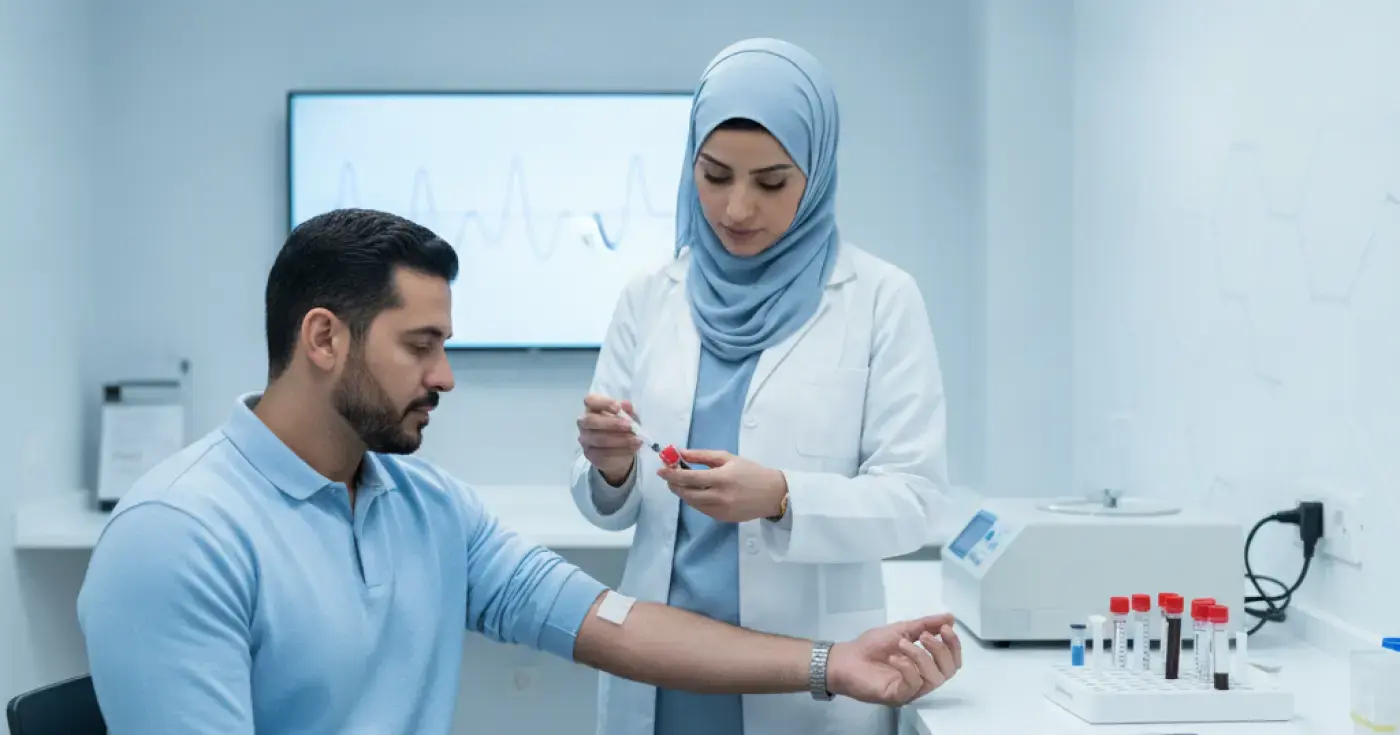
Learn why testosterone test timing matters, why morning samples are required, and how sleep, fasting, and medications affect your lab test results.
Read article
Learn when doctors order a testosterone test, common low testosterone symptoms, why morning testing matters, and how correct clinical diagnosis works.
Read article
Learn about azoospermia, zero sperm count analysis, the role of FSH and testosterone tests, and how urologists evaluate obstructive vs non-obstructive causes.
Read article