Lahalak Medical PlatformDifferentiate Care
Discover how non-surgical body contouring and cryolipolysis work, ideal candidates, clinical risks, and what to expect before and after your sessions.

Advertisement
In recent years, the field of aesthetic medicine in Saudi Arabia has experienced a significant shift toward minimally invasive and non-surgical procedures. non-surgical body contouring has emerged as a highly popular option for individuals seeking to refine their body shape without undergoing complex surgical interventions.
Among these advanced techniques, cryolipolysis (commonly known as fat freezing) stands out as a leading, clinically proven method approved by major international regulatory bodies and the Saudi Food and Drug Authority (SFDA). Understanding how this technology works, its clinical indications, and its limitations is essential before embarking on treatment sessions.
From a clinical perspective, patients must understand that body contouring is not a weight-loss solution. There is a fundamental biological difference between losing weight and contouring the body:
Therefore, cryolipolysis is designed for localized fat reduction in individuals who are already close to their target weight but struggle with stubborn fat pockets.
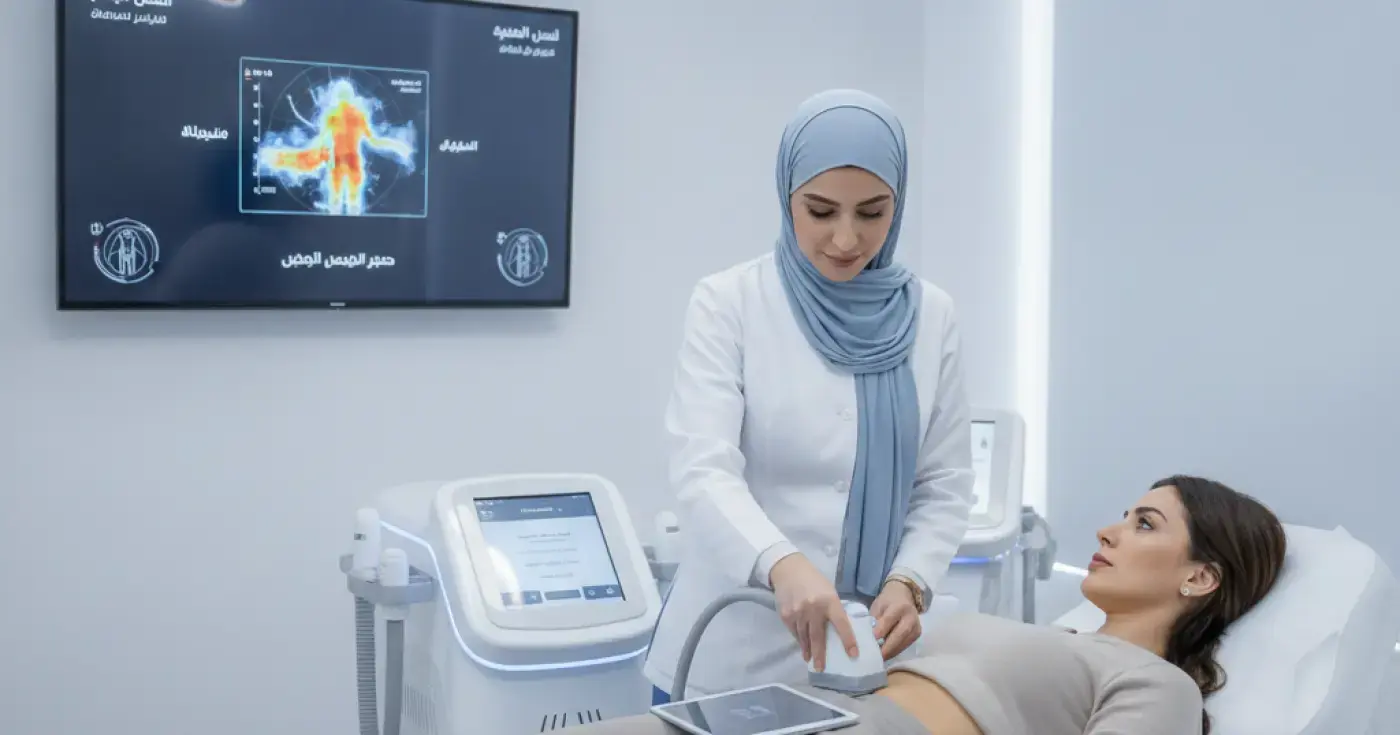
Cryolipolysis is based on the scientific principle that subcutaneous fat cells are naturally more vulnerable to cold temperatures than surrounding tissues, such as skin, nerves, blood vessels, and muscle. During the procedure, a specialized applicator delivers controlled cooling to the target area, lowering the temperature of the fat tissue to a level that triggers programmed cell death (apoptosis).
Over the weeks and months following the treatment, the body's lymphatic system naturally processes and eliminates the damaged, dead fat cells. This gradual clearance typically reduces the thickness of the fat layer in the treated area by 20% to 25% after a complete treatment cycle.
To ensure optimal clinical outcomes and patient satisfaction, a thorough pre-treatment medical consultation is required to determine candidacy. Ideal candidates generally meet the following criteria:
While cryolipolysis is highly safe, it is strictly contraindicated for individuals with certain medical conditions, including:
The procedure is entirely non-invasive and does not require anesthesia. A typical session involves the following steps:
Adhering to proper clinical guidelines before and after your session helps maximize results and minimize side effects:
This comparison table highlights the key differences between non-surgical fat freezing and surgical fat removal:
| Feature | Cryolipolysis (Fat Freezing) | Surgical liposuction |
|---|---|---|
| Invasiveness | Completely non-invasive; no incisions or needles. | Invasive surgical procedure requiring incisions. |
| Anesthesia | None required. | General anesthesia or deep local sedation. |
| Recovery Time | Zero downtime; immediate return to normal activities. | Requires 1 to 2 weeks of recovery and compression garments. |
| Result Timeline | Gradual improvement over 1 to 3 months. | Immediate improvement, fully visible after swelling subsides (1-6 months). |
| Potential Risks | Mild, temporary side effects (redness, bruising, numbness). | Surgical risks (infection, bleeding, asymmetry, anesthesia risks). |
| Sessions Needed | 1 to 3 sessions per targeted area. | Usually a single procedure is sufficient. |
Cryolipolysis is associated with minimal risk, but patients should be aware of common, self-limiting side effects:
In very rare instances (estimated at less than 0.05%), patients may experience Paradoxical Adipose Hyperplasia (PAH). Instead of shrinking, the fat cells in the treated area expand and harden into a painless, well-defined mass. While not medically dangerous, PAH does not resolve on its own and requires surgical liposuction to correct.
Because the body clears the destroyed fat cells gradually, results are not instantaneous. Initial changes may be noticed as early as 3 to 4 weeks post-treatment, with the most dramatic, visible contouring appearing between 2 and 3 months. The body can continue to flush out fat cells for up to 6 months after a session.
To maintain these results long-term, patients must commit to a healthy lifestyle. While the eliminated fat cells are gone forever, remaining fat cells in untreated areas can still expand if weight gain occurs. A stable weight is the key to preserving your new contour.
To ensure your safety and the efficacy of the treatment, always follow these guidelines when choosing a clinic in the Kingdom:
Clear, direct answers
Advertisement
Continue exploring
Explore the topic