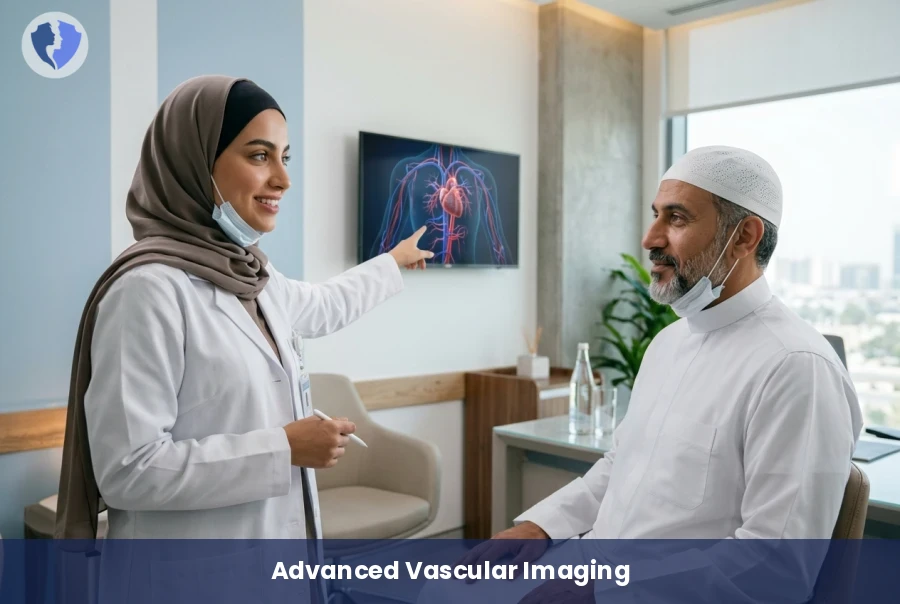
Advanced Angiography Scan - CT or MR Angiography
Definition: Highly advanced, non-invasive vascular imaging methodologies employing Computed Tomography (CT) or Magnetic Resonance (MR) technological platforms. First: CT Angiography (CTA). Underlying Principle: Ultra-fast tomographic scanning executed instantaneously following a rapid bolus injection of an iodinated contrast medium. Equipment Required: Multi-detector CT scanners (64-slice minimum capability), synchronized dual-head automated power injectors, and proprietary 3D vascular reconstruction software. Procedural Protocols: Precise timing captures the Arterial phase (15-25 seconds post-injection) and Venous phase (45-70 seconds post-injection), often implementing ECG-gating specifically for pristine coronary artery visualization. Diagnostic Accuracy: Extremely high spatial resolution (< 1 mm) allowing for the definitive diagnosis of > 50% arterial luminal stenosis. Second: MR Angiography (MRA). Underlying Principle: Exploits the intrinsic biophysical phenomena of flowing blood, executable with or without the integration of a Gadolinium-based contrast agent. Imaging Techniques: Time-of-Flight (TOF) utilized for rapid blood flow without contrast; Phase-Contrast (PC) intended for quantifying flow direction and velocity; and Contrast-Enhanced MRA, representing the most universally applied and accurate modality. MR Clinical Advantages over CT: A complete absence of ionizing radiation, the unique capacity to generate functional hemodynamic data (flow dynamics and velocity profiles), and an unparalleled safety profile when imaging radiation-sensitive vascular beds, notably within the pelvic region.